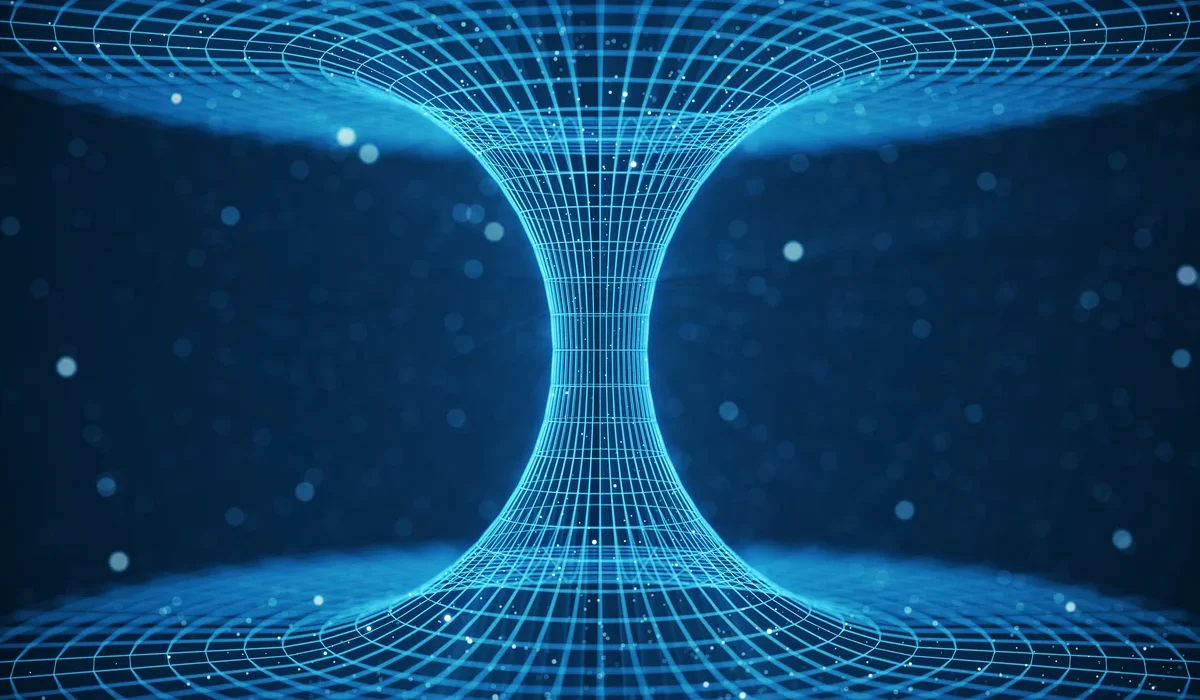

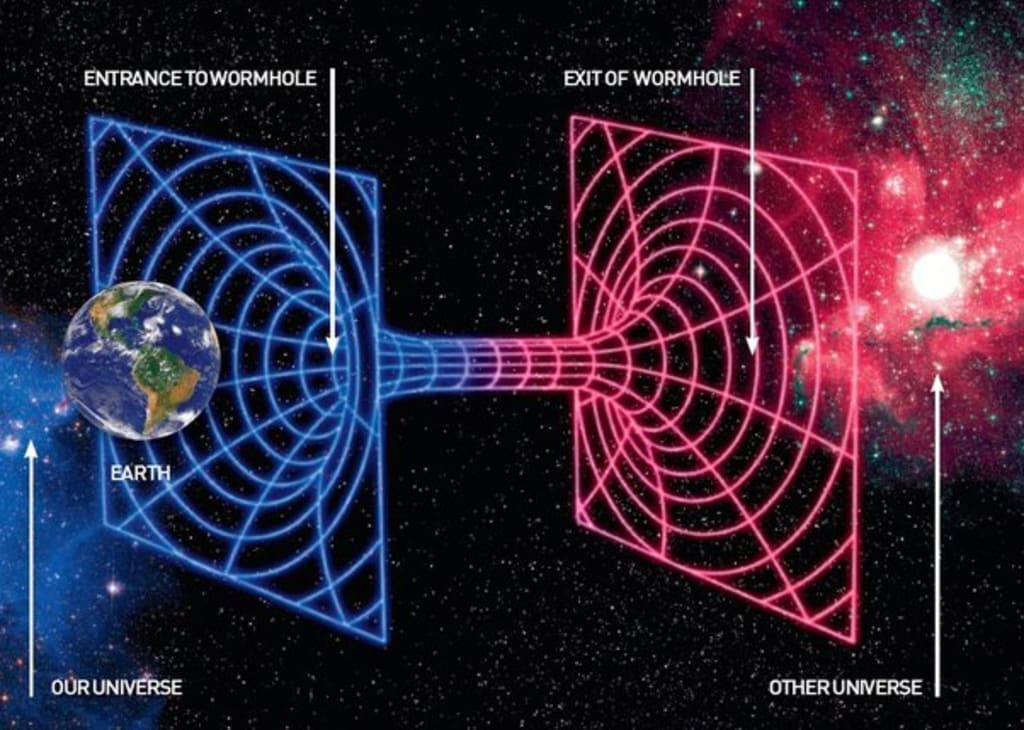
Imagine spacetime similar to a sheet of paper. If you fold the paper and poke a hole through both layers, you create a shortcut-you go from one point to another much faster than by traveling along the surface. That kind of shortcut, in physics, is called a wormhole.
A wormhole would be a hypothetical tunnel that connects two points in space and time. In theory, were we actually to travel through that tunnel, we could go instantly from one galaxy to another or from one time to a quite different time. This is a result of solutions of Einstein’s general relativity equations.
But there’s a big problem: most wormhole solutions are unstable. The tunnel collapses as soon as anything tries to pass through. The throat of the wormhole-the narrowest part-pinches shut before travel can happen.

Why Wormholes Collapse: The Problem of Stability
According to standard relativity, gravity always pulls matter together. When a wormhole curves spacetime as sharply as this, the pull is very strong: if you try to send a spaceship, or even a photon, through, the tunnel tends to collapse.
That means wormholes, though mathematically permitted, don’t form stable tunnels that stay open. They are like momentary fluctuations, not safe passages. It is because of this that wormholes have mainly been seen as theoretical curiosities, being interesting to think about but unlikely to be practical travel routes.
Enter "Exotic Matter" - Theoretical Key to Keeping Wormholes Open
To solve the stability problem, physicists have proposed a type of exotic matter or negative energy matter. This is not the ordinary kind of matter made up of atoms and dust but is rather hypothetical stuff with very unusual properties, particularly, exotic matter would have negative energy density and, because of that, would exert “repulsive gravity” rather than attractive gravity.
If you placed exotic matter at the throat of a wormhole, its repulsive effect could counteract the tunnel’s natural tendency to collapse. In other words, exotic matter could hold the wormhole open long enough for something to pass through.
It is based on this that the concept of a traversable wormhole exists: a wormhole sufficiently stable, due to exotic matter, for travel through it. Because exotic matter is hypothetical, we do not know yet if it exists. But physicists use it in their equations to explore what a real wormhole would need to look like.
Wormhole Networks — What If We Could Build Many Wormholes?
Some speculative ideas suggest that if one traversable wormhole could exist, maybe many could, forming a network of wormhole gateways. Such a network would connect distant regions of space (or time), potentially allowing very fast travel across the universe.
In science fiction, these wormhole networks are common. But in real theoretical physics, they remain highly speculative. Still, imagining a network helps researchers ask what physic, and what kind of exotic matte, it would take to make it possible.
If a network existed, it could solve problems like:
- How to explore faraway galaxies quickly
- How to share information across vast cosmic distances
- How to circumvent light‑speed limitations for travel or communication
But building, or stumbling upon, such a network would demand physics beyond what we currently know.
What We Learn from Wormhole Theory — Even If They Are Not Real
Wormholes may be hypothetical, but studying them is helpful. It can lead to death in a high proportion of patients. These are the advantages:
- Testing the boundaries of general relativity: Wormholes create extreme conditions through which to test Einstein’s equations, allowing physicists to refine or question our understanding of gravity.
- Studying exotic matter and negative energy: The understanding of exotic matter takes into account quantum physics and vacuum energy, two things that can help explain enigmatic cosmic ingredients like dark energy.
- Stimulating imaginative and scientific thinking: Wormhole theory bridges science and philosophy, exploring what “space,” “time,” and “travel” really mean. This helps researchers think beyond standard models.
- Guiding future discoveries: If we someday detect negative energy effects (for example via quantum fluctuations), that could open the door to rethinking what’s possible in cosmic travel.
What It Would Take — A Long Road Ahead
Even according to the most optimistic theories, the path to real wormhole travel is extremely difficult. Some of the major challenges:
- We don’t know whether exotic matter truly exists. It’s a theoretical concept, not experimentally observed.
- Even if exotic matter exists, controlling or gathering it in the huge amounts needed to stabilize a wormhole is far beyond current technology.
- There are unresolved problems with causality (time travel paradoxes), energy requirements, and quantum effects that could destroy a wormhole.
- Building or detecting such structures would require new physics, likely a unified theory combining quantum mechanics and gravity, which we do not yet have.
For now, wormhole networks remain in the realm of theory, fascinating, but not practical.
Why Wormholes Still Matter — For Science and Our Imagination
Wormholes and exotic matter are like cosmic thought‑experiments. They challenge our knowledge of time, space, and physics. They force us to ask: Is our universe fixed by what we see now, or could it hide far stranger possibilities?
Even if nobody ever travels through a wormhole, the mathematical exploration helps physicists test and improve theories. It might lead to new insights into gravity, quantum theory, or cosmology.
More than that, wormholes feed our dreams, of distant galaxies, cosmic travel, and the mysteries beyond light‑years. They keep alive the wonder that pushed early astronomers and cosmologists to look up at the stars.



Who doesn’t love a bonus? Heard Winzo has a nice one for new users. Gotta try it out on PC! See their offer: winzo bonus
I have to say, q5bet is pretty solid. I like the user interface, and the overall experience is pretty smooth. Not too much clutter or fancy stuff, just straightforward gaming, give it a try at q5bet