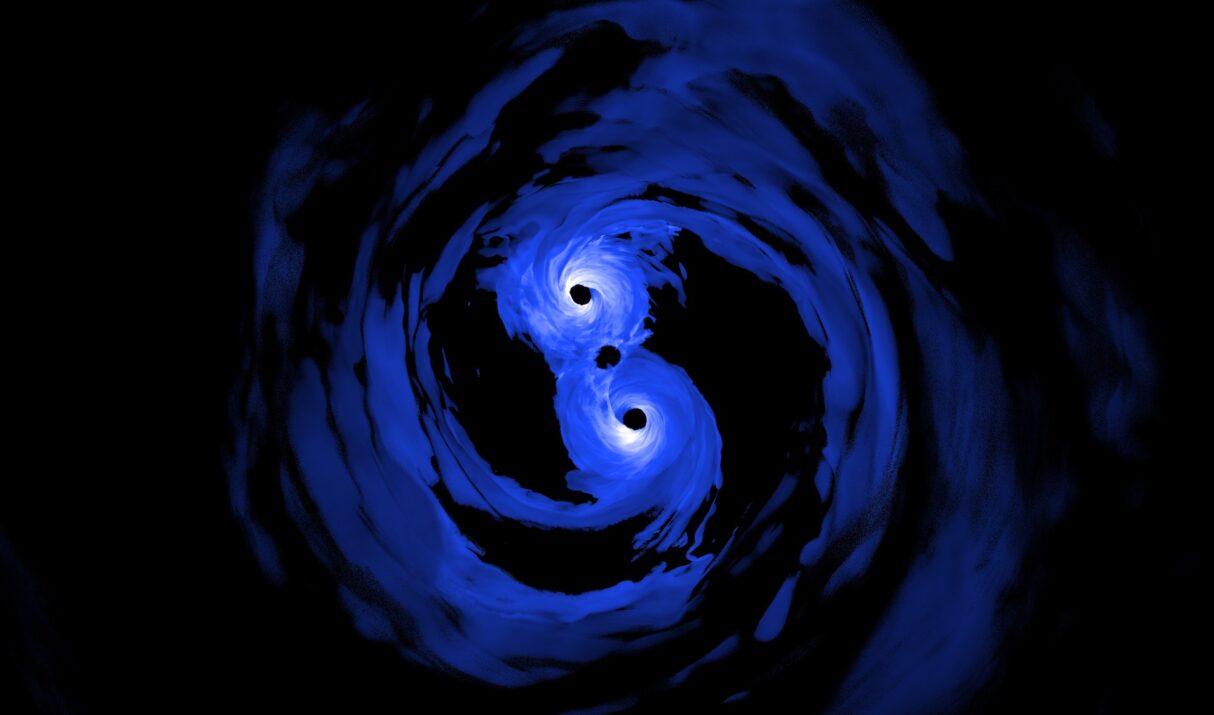

Tiny ripples stacking from many cosmic sources could be stronger than we thought, now offering new ways to study the early universe.

A solar system comet, C/2025 K1 (ATLAS), shattered into pieces after passing near the Sun — a rare cosmic breakup now unfolding.

A new study suggests we may have finally glimpsed dark matter, gamma rays from our Milky Way’s core might be its long‑lost signal.

Euclid’s latest image exposes a dusty, star-forming cloud in Orion, unveiling how young stars are born behind thick cosmic curtains.

What if our 3D universe is actually a projection encoded on a two‑dimensional boundary? The holographic principle offers this radical possibility.

Astronomers uncover a distant galaxy blazing with star formation at 180 times our Milky Way’s rate, reshaping our view of early cosmic growth.

Scientists observed a supermassive black hole flare shining like ten trillion suns, marking the most distant and brightest flare ever detected.

Discover how far we can see into the universe, what defines our cosmic horizon, and why some regions remain forever hidden.

New research suggests the universe’s expansion is now decelerating rather than accelerating, challenging dark energy and rewriting cosmic destiny.