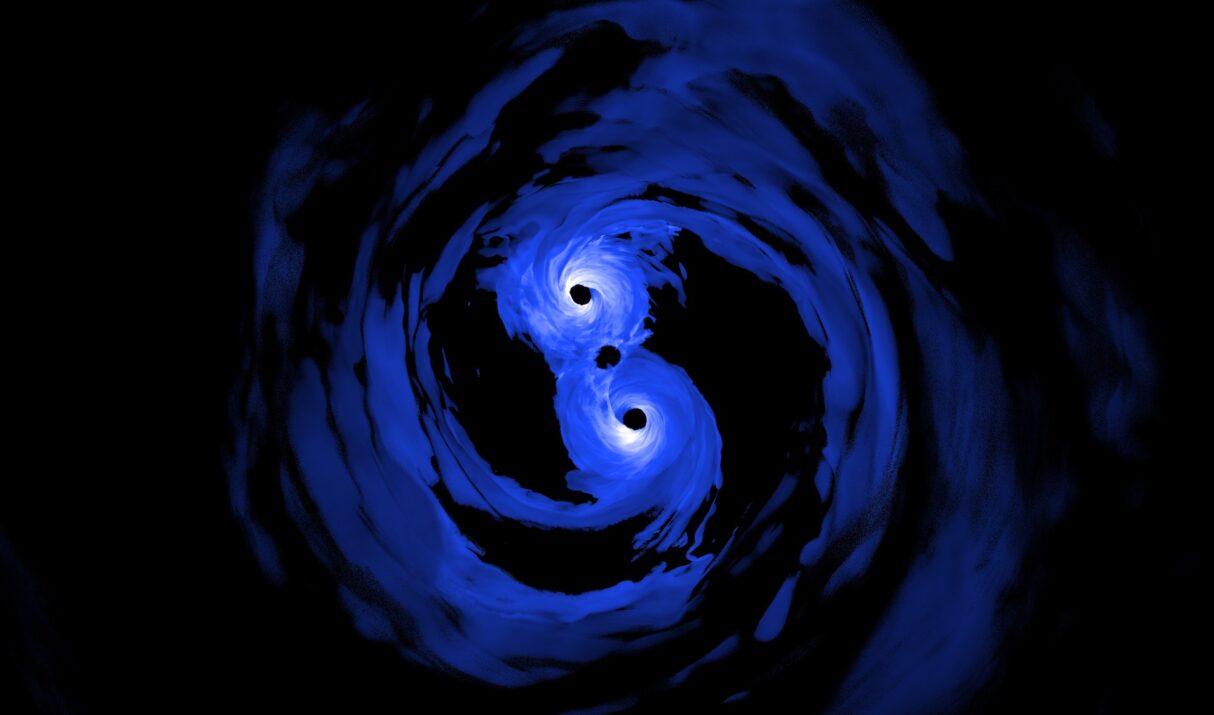

Tiny ripples stacking from many cosmic sources could be stronger than we thought, now offering new ways to study the early universe.

Scientists explore whether exotic matter could stabilize wormholes, cosmic tunnels that might let us travel across the universe through spacetime shortcuts.

A solar system comet, C/2025 K1 (ATLAS), shattered into pieces after passing near the Sun — a rare cosmic breakup now unfolding.

Euclid’s latest image exposes a dusty, star-forming cloud in Orion, unveiling how young stars are born behind thick cosmic curtains.

What if our 3D universe is actually a projection encoded on a two‑dimensional boundary? The holographic principle offers this radical possibility.

A Turkish-led team has confirmed four new exoplanets, including one that might be inside a star’s habitable zone, offering exciting scientific possibilities.

Astronomers uncover a distant galaxy blazing with star formation at 180 times our Milky Way’s rate, reshaping our view of early cosmic growth.

Comet 3I/ATLAS, an interstellar visitor, now shows multiple jets and anti-tails in high-detail images, reshaping our view of cosmic wanderers.

Scientists observed a supermassive black hole flare shining like ten trillion suns, marking the most distant and brightest flare ever detected.