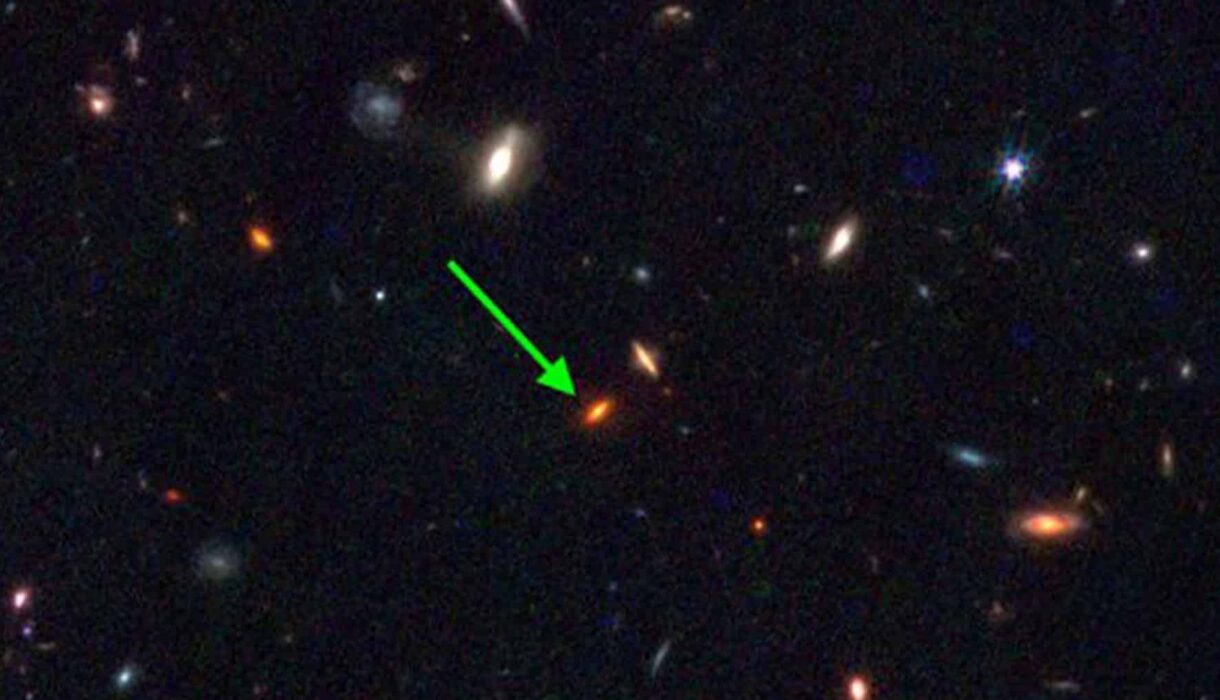

In November 2025, astronomers announced the discovery of a distant galaxy, designated Y1, that is forming stars at an extraordinary rate—around 180 times faster than our Milky Way. What makes Y1 even more remarkable is its age: we see it as it was just 600 million years after the Big Bang, when the universe was less than 5% of its current age. The galaxy’s intense star-building activity and hot dust signature are challenging long-held ideas of how early galaxies formed and grew.
How it was discovered
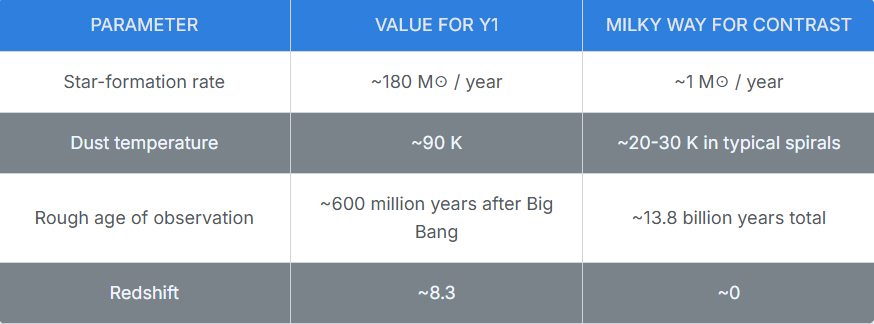
The team, led by Dr. Tom Bakx from Chalmers University of Technology in Sweden, combined data from the Atacama Large Millimeter/submillimeter Array (ALMA) and the James Webb Space Telescope (JWST). They used ALMA’s Band 9 instrument at ~0.44 mm wavelength to measure the dust emission from Y1, finding the dust temperature at an unusually high ~90 Kelvin (-180 °C). That temperature is much warmer than comparable distant galaxies, indicating intense heating by newly-formed stars.
JWST’s infrared imaging unveiled stellar structures and allowed the team to confirm the galaxy’s large mass and intense activity. Its redshift is ~8.3, placing the origin of light over 13 billion years ago.
Why this galaxy stands out
Galaxies in the early universe are usually thought to form stars at modest rates, gradually building up mass. Y1 breaks that mold:
- Its star-formation rate is ~180 solar masses per year, versus ~1 for the Milky Way.
- The dust temperature is much higher than expected, meaning star-forming regions are extremely energetic.
- It points to a rapid growth mechanism, possibly triggered by large gas inflows or very efficient star-burst episodes.
The existence of such a rapid, efficient star factory so early suggests that some galaxies reached large size and maturity much sooner than theoretical models had predicted. The result may force cosmologists to revisit how quickly large structures formed, and how dust built up so early.
What this means for cosmic evolution
The early universe presented conditions very different from our local neighborhood. Y1 offers a natural laboratory to study those conditions. Some key implications:
- Galaxy formation timeline: If there had been more galaxies like Y1, then the large galaxies would have populated the universe much earlier than thought.
- Dust production puzzle: Earlier studies found more dust in early galaxies than expected. The high dust temperature in Y1 could help solve this by showing that even smaller amounts of warm dust can glow intensely
- Starburst physics: the mechanics of how gas funnels into young galaxies and forms stars must account for such extreme behaviour.
- Feedback and structure formation: With so many stars forming, the feedback-supernovae, radiation pressure, winds-could shape early galaxy evolution in ways models must capture.
Observing the galaxy: how it was measured
It was all about the combination of ALMA and JWST. ALMA traced the millimetre emission of dust, while JWST recorded infrared light from stars and heated gas. What happened in order:
- Detection of redshift and star-forming signature via JWST.
- Dust temperature measurement via ALMA’s Band 9.
- Calculation of star-formation rate based on emission lines, dust luminosity, and mass estimates.
By combining methods, the team could infer how energetic, and how massive, this galaxy was, despite its remote location.
Here’s a quick comparison in table form:
What is not known
There are still many open questions despite this breakthrough.
- Was Y1 unique or representative of the wider population of galaxies in early times?
- What caused its rapid growth-a merger, a cold-gas stream, or an environment rich in star-forming fuel?
- How much heavy elements – metals – and dust does it actually contain, and how were they produced so early?
- Will future telescopes find even more extreme star-factories or reveal diversity in early galaxy evolution?
Future observing campaigns will be directed at finding more galaxies like Y1, mapping their gas inflow, dust content, and starburst lifetimes, with the aim of building a fuller picture of the cosmic dawn.