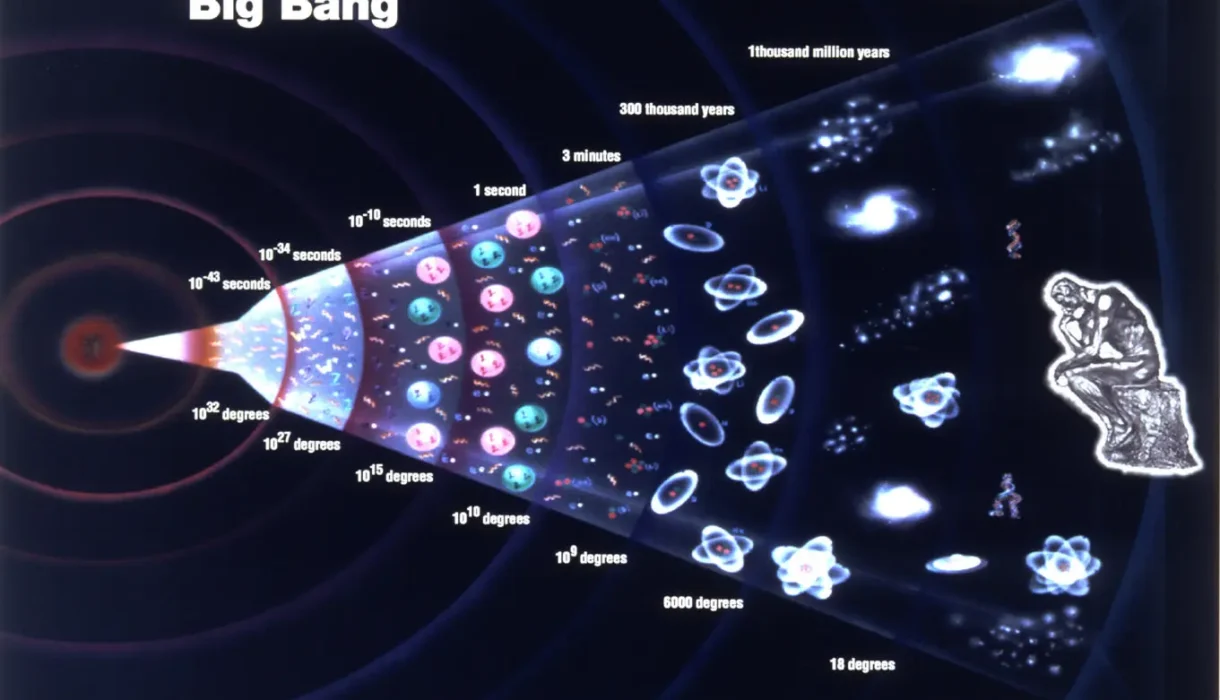

One of the biggest puzzles in cosmology is why our universe contains so much more matter than antimatter. The asymmetry is not fully explained by the Standard Model of physics. One intriguing theoretical concept; the mirror universe, proposes that a complete parallel sector of particles might exist, and this mirror world could hold the key to solving the imbalance.
These mirror universe models have the property that each particle we know has a mirror twin: a “mirror electron,” “mirror proton,” and so on. These mirror particles form their own sector, which interacts among itself via mirror electromagnetism, weak interactions, and strong interactions. The only force connecting our world to the mirror world is gravity.
How Mirror Symmetry Works in Theory
The theory postulates a parity symmetry, or “mirror parity”, between our universe and the mirror sector. Although the two sectors are virtually identical, the conditions under which they work may be a little different; for instance, the mirror sector may be colder or more weakly interacting, which helps explain why we don’t easily measure it.
In some variants, mirror symmetry can be spontaneously broken during the early universe, such that all the parameters of the mirror sector-including its particle masses and interaction strengths-become different from ours. This broken symmetry could give rise to the dominance of matter in the universe, while the mirror sector becomes a viable candidate for dark matter.
Another key prediction is the possibility that particles such as neutrons or kaons could oscillate into their mirror counterparts, leaving testable signals in labs. These oscillations are potential messengers between the two sectors.
Why a mirror universe helps explain the imbalance
The mirror theory provides some elegant solutions to some long-standing cosmological puzzles:
- Matter-Antimatter Asymmetry: Instead of proposing completely new particles or forces, in mirror models, the asymmetries between the two sectors would naturally generate more matter on our side.
- Dark Matter: Mirror particles interact hardly with “real” matter and are hence invisible, a perfect candidate for dark matter.
MDPI - Neutron Lifetime Anomaly: Some experiments report anomalies in the neutron lifetime; the concept of mirror neutron oscillation could explain this.
- Testable Predictions: The theory postulates that experiments might search for invisible decays of neutral hadrons or oscillations into mirror states.
Criticism and Challenges
While the prospect of the mirror universe is intriguing, there are some very major hurdles associated with said concept.
Empirical Evidence Lacking
- Empirical Evidence Lacking: So far, there is no direct and widely accepted detection of mirror particles or their oscillations in experiments.
- Weak Coupling: Because the mirror sector interacts so weakly-only gravitational or tiny portal couplings-its existence is rather difficult to confirm technically.
- Cosmological Constraints: A mirror sector needs to be “cold” or highly dilute; otherwise, it would perturb the early universe in ways that we ought already to have seen, via for example the cosmic microwave background or big bang nucleosynthesis.
- Parameter Tuning: Many theories explain dark matter and matter asymmetry in one go, but need specific values for the masses, coupling strengths, and symmetry-breaking scales. Critics say that this looks “fine-tuned.”
What’s New and Why It Matters Today
Recent theoretical work has brought the mirror universe back into the spotlight. A 2024 paper in the Journal of High Energy Physics revisited the idea, with modern cosmological data, to argue that the coincidence of baryon and dark matter densities might hint at an underlying mirror symmetry.
Meanwhile, experiments are being proposed to test mirror predictions more directly. For example:
- Search for neutron-mirror neutron oscillations using strong magnetic traps.
- Looking for invisible decays of neutral hadrons like kaons that could jump into mirror particles.
If any of those are confirmed, it would be a major breakthrough: not just for particle physics, but for cosmology.
Why This Hypothesis Captures Imagination
- Elegant Simplicity: The idea of the mirror world does not invent completely new particles; rather, it copies what we already know into a logical extension.
- Unifying Problems: It ties together the problems of dark matter, the matter-antimatter imbalance, and neutron anomalies in one framework.
- Testable: Unlike many speculative ideas, some of these mirror models make real predictions, meaning experiments could prove or rule them out.
- Balance: There’s some appeal philosophically, possibly the universe really is balanced, just hidden, in a way we don’t easily see.
What to Watch Next
- Lab Experiments: Improved neutron‐oscillation measurements, invisible decay searches, and refined precision tests.
- Cosmological data: CMB measurements, large-scale structure, and early-universe signatures may provide indirect evidence for the existence of a mirror sector.
- Theory Development: Improved models that link mirror symmetry with inflation, reheating or other processes in the early universe.
Watch to know more
Final Thoughts
The mirror universe is a bold and beautiful theory, one bringing new light to why matter dominates over antimatter and what dark matter really is. While this remains a speculative idea, the concrete prediction thereof goes deep into the links between cosmology, particle physics, and the basic nature of symmetry. If the mirror world exists, we may not need to rewrite the entire physics but just extend our understanding to a hidden twin sector that coexists with our own.