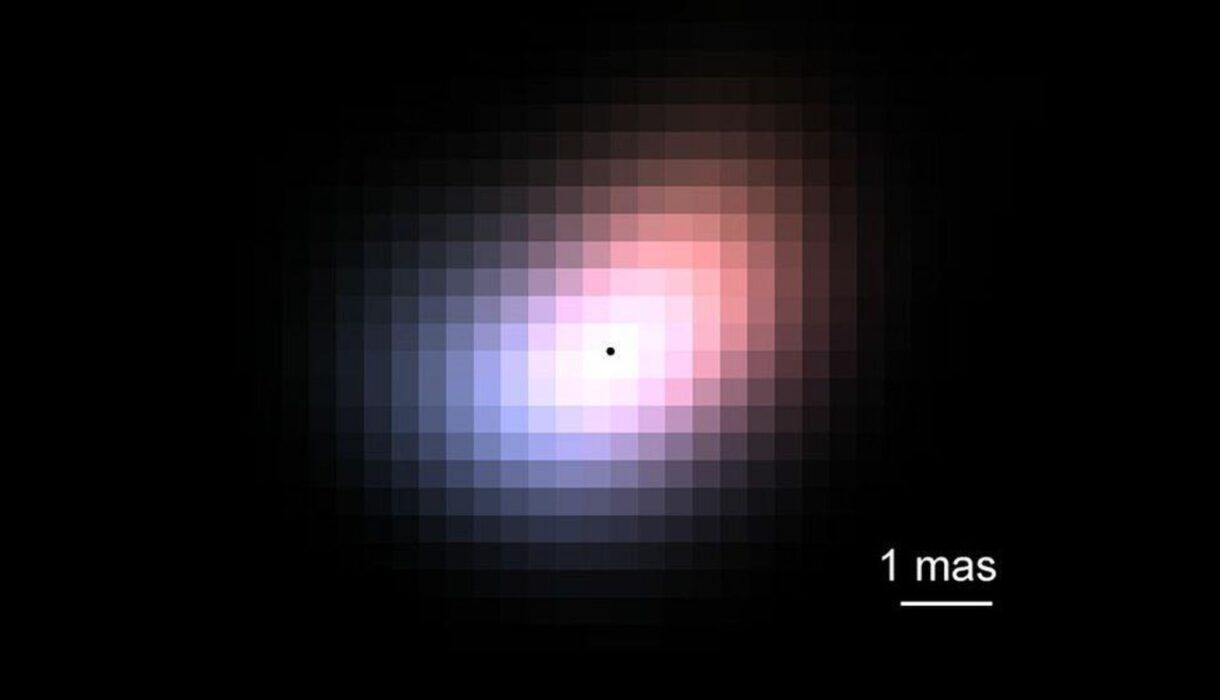

Astronomers announced on 30 October 2025 an astonishing observation of the nearby star known as Gomeisa, alias Beta Canis Minoris, hosting a very asymmetric disk of hydrogen gas. Using a photonic lantern, a new instrument attached to the Subaru Telescope in Hawaii, the team took one of the sharpest single-telescope images of its kind. The gas disk looks lopsided, with one side significantly brighter and more extended compared to the other; this is something that subtler instruments could not detect before.
What is Gomeisa and why it's interesting
Gomeisa is a star about 162 light-years from Earth, roughly 3.5 times more massive than the Sun. Though it’s visible to the naked eye in the constellation Canis Minoris, its surrounding disk was only recently studied in this detail. By studying such star-disk systems, scientists study how planets, disks, and companions form around stars. The asymmetry found in Gomeisa complicates standard models of smooth, symmetric disks and suggests new physics or nearby hidden companions might be influencing the system.
The photonic lantern instrument
A fundamental problem for traditional ground-based telescopes is that Earth’s atmosphere distorts starlight. A photonic lantern is a fibre-optic device which channels incoming light into many separate channels, each independently correcting the distortions, and then recombines them to yield a sharper image. This technology enabled the Subaru Telescope to resolve for the first time the fine details in the gas disk hidden so far by atmospheric blur or instrumental limits. The success demonstrates a major upgrade in observational capability from the ground.
What the asymmetry tells us
Why is the disk around Gomeisa so lopsided? Several explanations are possible, including:
- There could be an unseen stellar or planetary companion that is pulling on the disk and causing the gas to pile up on one side.
- Something may be asymmetrical with the radiation pressure, winds, or magnetic fields of the host star interacting with the disk.
- This might be because the disk is in an early stage of formation or collapse where instabilities naturally create asymmetric shapes.
By mapping the Doppler shift of the gas-its blue side moving toward us, its red side moving away-the team found that one half of the disk rotates differently from what would be expected, which showcases that its motion is not symmetric. Such asymmetry is a telltale sign of external influence, or internal turbulence, more extreme than hitherto appreciated in young star-disk systems.
Implications for planet and star formation
Disks around stars are the birthplaces of planets. If an early disk is significantly asymmetrical, then that could impact where and how planets would form. The places with more mass can collapse faster and build bigger planets or clusters. A lopsided disk might also affect the migration paths of planets, thereby producing unusual orbital patterns. To the cosmologists and astronomers, this means planet formation may be far more varied and chaotic than standard models predict.
What's next in the study
This finding opens the way to further research:
- High-resolution infrared observations will search for hidden companions, stars or large planets, embedded within the disk.
- Radio telescopes will be tracing colder dust and molecular gas to see how the full structure matches up with the observed hydrogen gas.
- Time-series observations will show whether the asymmetry changes over months or years, which would point to dynamic processes.
- More stars will be surveyed with photonic lanterns to determine if Gomeisa is an anomaly, or if it’s part of a broader class of asymmetric disks.
Why this matters now
This finding is important because it changes our expectations of how disks look and behave: instead of neat, smooth disks moving around stars, reality can be messier. Understanding these asymmetries provides better insight into how our Solar System might have evolved, how common exoplanet systems might differ, and how stellar environments shape planetary architecture.
Conclusion
For star-watchers, Gomeisa is situated in the small constellation of Canis Minoris, the Lesser Dog. Though the disk itself is far too small to see with amateur telescopes, the star’s location is accessible in dark skies. Interested observers can follow the Subaru team’s public data releases and images posted on observatory websites or social media.