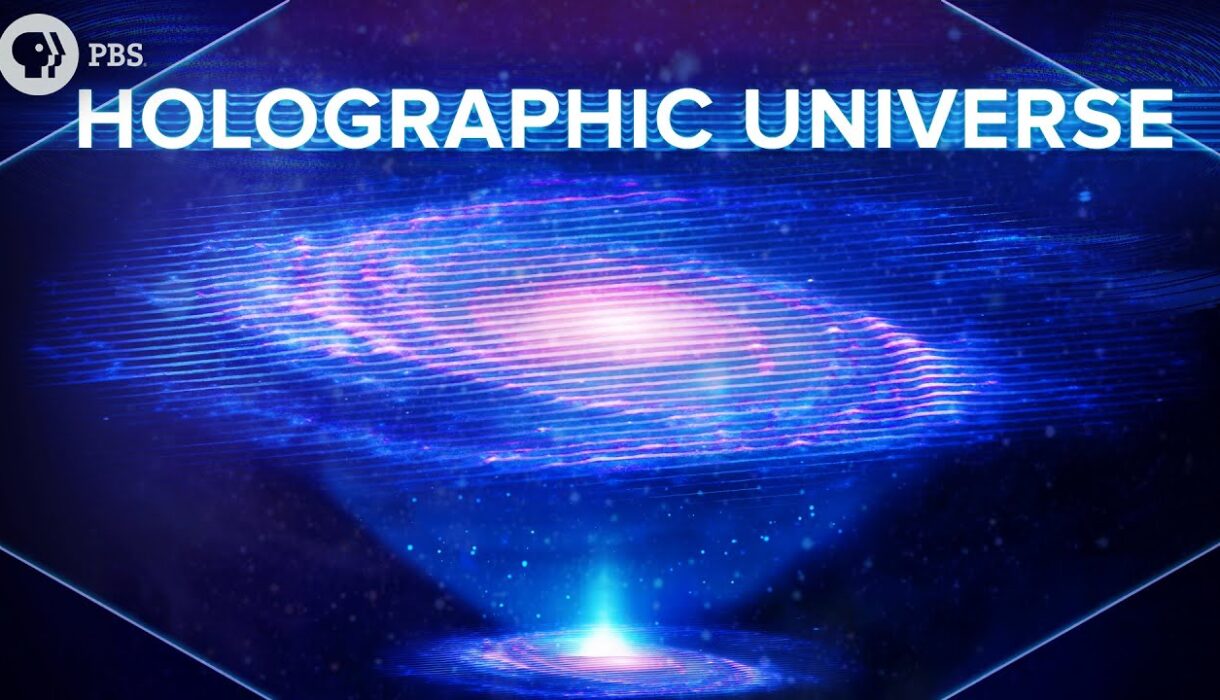

Imagine that everything you see: galaxies, stars, even you-are just a three‑dimensional image projected from a flat surface. It sounds like science fiction, but in theoretical physics, this is called the holographic principle. First proposed by Gerard ’t Hooft and later refined by Leonard Susskind, this theory asserts that the information contained in a volume of space can be fully described by data on its boundary. Another way of saying it is that our 3D universe might have been “painted” on a distant 2D surface.
The principle originated with black hole physics: It was found that the entropy-if considered a measure of information-of a black hole is proportional to its surface area and not to its volume. This was puzzling: if information were stored by volume, bigger space would mean much more information, but black holes seemed to defy that. The holographic principle offers a solution: maybe all that information is encoded on the boundary, not inside.
How the Principle Works in Cosmology
To understand how this applies to the universe, consider a cosmic horizon, a boundary far beyond any we can perceive. According to the holographic view, all information about the universe could, in theory, be encoded on that surface. What we perceive as three-dimensional space might arise from simpler data of two dimensions.
One big motivation for the theory comes from trying to merge quantum mechanics, the physics of the very small, with Einstein’s gravity, the physics of space and time. The holographic principle suggests that gravity may not be a fundamental force at all but is instead an emergent phenomenon that comes from the hidden information on that 2D surface.
More technically, the researchers draw on the mathematical framework of AdS/CFT correspondence, discovered by Juan Maldacena. It demonstrates exactly how a gravitational theory in one higher-dimensional space can be equivalent to a quantum field theory on its lower-dimensional boundary. Even though our universe isn’t exactly Anti-de Sitter (AdS) space, this idea inspires scientists to consider such dual relationships in cosmology.
What it means for Reality
If indeed the universe works that way, this changes our thinking about space, time, and information:
- Dimensions are emergent: The three-dimensional world we experience wouldn’t be “real” in the deepest sense; it is a kind of projection from a more fundamental surface.
- Information storage: All particles, fields, even your thoughts might be represented by data on a boundary. That surface could hold the full blueprint of everything inside.
- Gravity as emergent: Instead of being built into space-time, gravity would be an emergent property of informational or quantum processes occurring at that boundary.
These are not merely the stuff of thought experiments; rather, they have real implications for solving some deep puzzles in physics, such as how to reconcile the laws of quantum mechanics with gravity or what happens inside black holes.
Challenges and Criticism
Of course, this is a theoretical model, it’s still far from proven:
- Lack of a precise formulation: Although physicists have made some progress, a complete, rigorous holographic theory for our universe-which expands, in contrast to AdS space-is still lacking.
- Growing boundary problem: Our cosmic horizon isn’t static-it grows. That means the “surface” carrying the encoded information is changing, which complicates the math.
- Testing the theory: Since we can’t easily access the boundary or read its “encoded data,” it’s extremely hard to test directly. Predictions become subtle, and distinguishing aspects of holography from other theories becomes quite challenging.
Why Scientists Care About It
Scientists love this idea, as it offers a bridge between worlds. It has the potential to connect:
- Quantum worlds: tiny particles, quantum weirdness
- Cosmic scale: galaxies, black holes, the universe itself
- Information theory: how data, entropy, and information flow in nature.
If proved, the holographic principle might shape the very basis of our understanding of the universe. It may also guide new theories of quantum gravity, shed light on what happens inside black holes, and change our understanding of space and time.
Scientists love this idea, as it offers a bridge between worlds. It has the potential to connect:
- Quantum worlds: tiny particles, quantum weirdness
- Cosmic scale: galaxies, black holes, the universe itself
- Information theory: how data, entropy, and information flow in nature.
If proved, the holographic principle might shape the very basis of our understanding of the universe. It may also guide new theories of quantum gravity, shed light on what happens inside black holes, and change our understanding of space and time.
What's Next in Research
- These ideas are being applied to real expanding universes, rather than static or idealized spaces, by developing holographic cosmology models.
- Efforts are in place to constrain these models using observational data, for example, cosmic microwave background patterns or the distribution of galaxies.
- Quantum gravity researchers are investigating novel mathematical techniques to more rigorously define how information is encoded on the surface of the cosmos.
Conclusion
The holographic principle is one of the most mind-bending ideas in cosmology: it suggests our universe might be a projection, that reality is fundamentally encoded on a two-dimensional boundary. While still speculative, the principle is backed by serious theory and mathematics, offering a new way to think about space, time, and information. If true, the universe we see might be just a “hologram”, a shadow of a deeper, more fundamental realm.