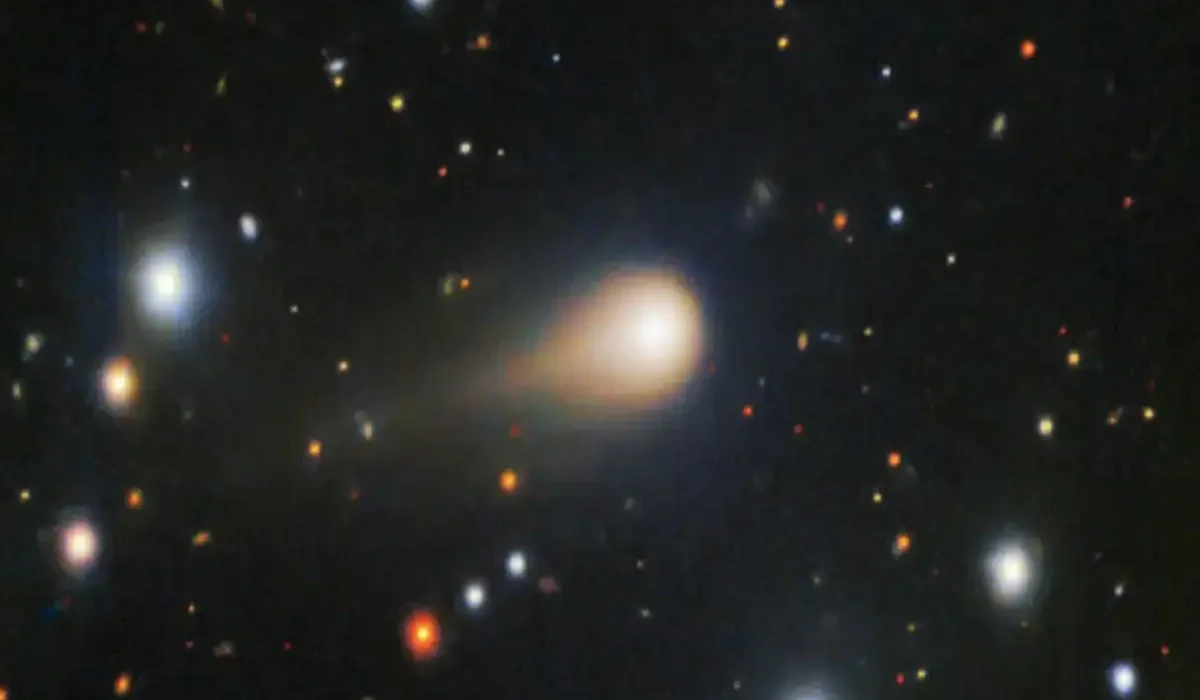

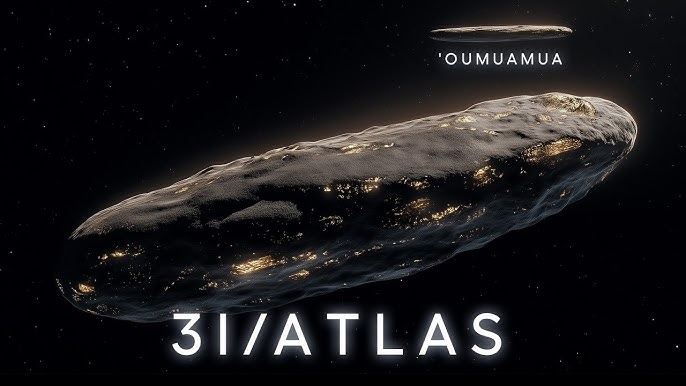
Observers of astronomy the world over are abuzz with 3I/ATLAS, an interstellar comet, also called C/2025 N1. This object, originating from outside our Solar System, recently passed perihelion on 30 October 2025 and has emerged from the Sun’s glare to display surprising features. New images taken on 8-9 November display multiple jets and a striking anti-tail structure-a phenomenon where dust and debris appear to stretch ahead of the comet’s motion. These features are indicative of complex physics and a dynamic history that could be characteristic of this cosmic intruder.

Understanding the details
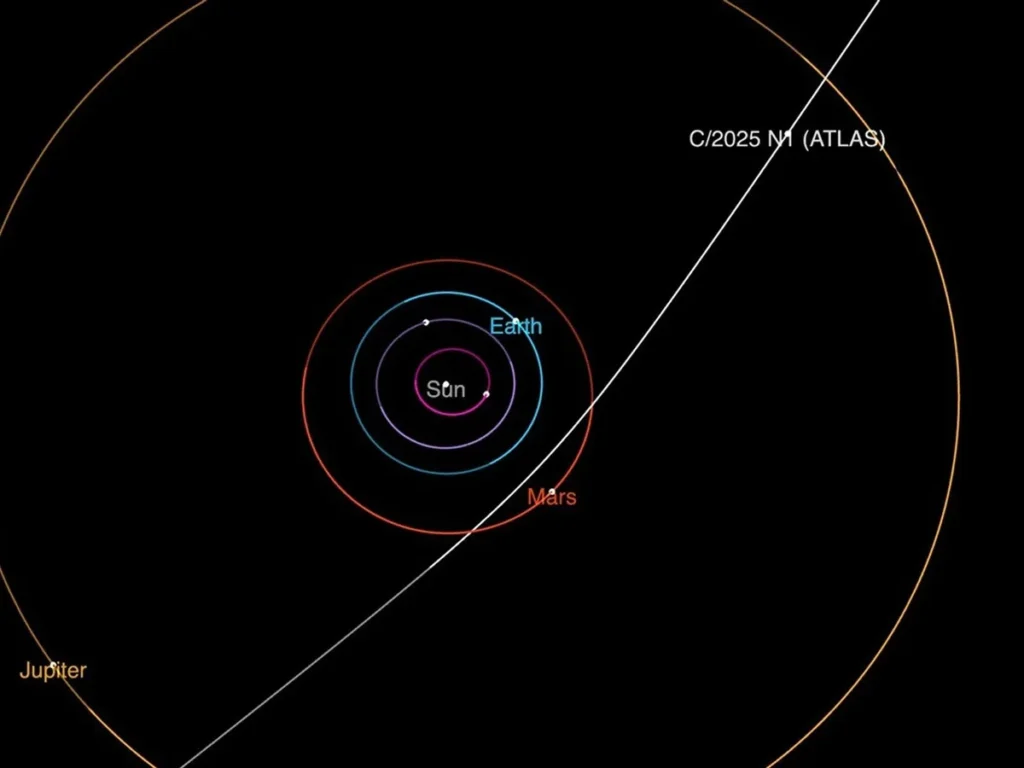
What makes 3I/ATLAS special? Its orbit is strongly hyperbolic, with high eccentricity; it is not bound to our Sun and will finally leave the Solar System. It reached its closest approach to the Sun at about 1.4 AU (~210 million km) and is moving at speeds around 68 km/s near perihelion.
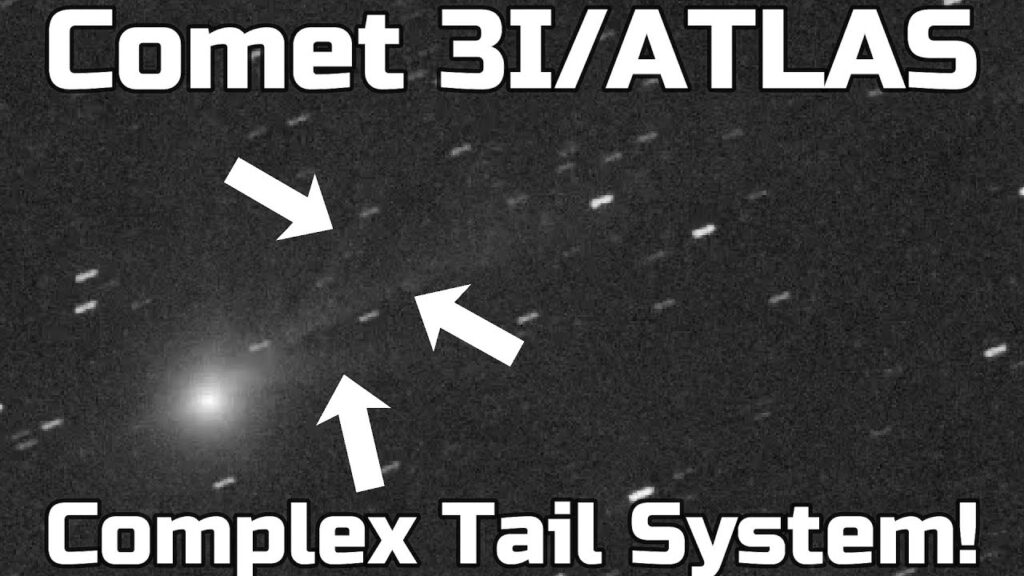
In early November, when the comet was in its post-perihelion phase, observers recorded several narrow jets of gas and dust emanating from its nucleus. According to Dr. Qicheng Zhang and colleagues, this jet activity is a sign that a large fraction of the mass of this comet may have been ejected in the vicinity of perihelion -far more than is the case for typical Solar System comets. Antitails, seen when debris trails happen to align with our line of sight, further support the hypothesis of high non-gravitational forces.
Why the jets and anti-tail matter
Most comets in the Solar System develop one or two main jets when heated by solar radiation, which in turn drives material away. The presence of multiple jets radiating in many directions and a clear anti-tail in 3I/ATLAS is an indication that this may be a far more extreme case: either a greater reservoir of volatile material, a recent major disruption event, or unique internal structure shaped outside our system.
This matters because 3I/ATLAS lets astronomers ask whether interstellar comets are fundamentally different from our local ones. If they are, that tells us about formation environments around other stars. The complexity seen in 3I/ATLAS may reflect its origin in a system very different from ours.
Observing this visitor
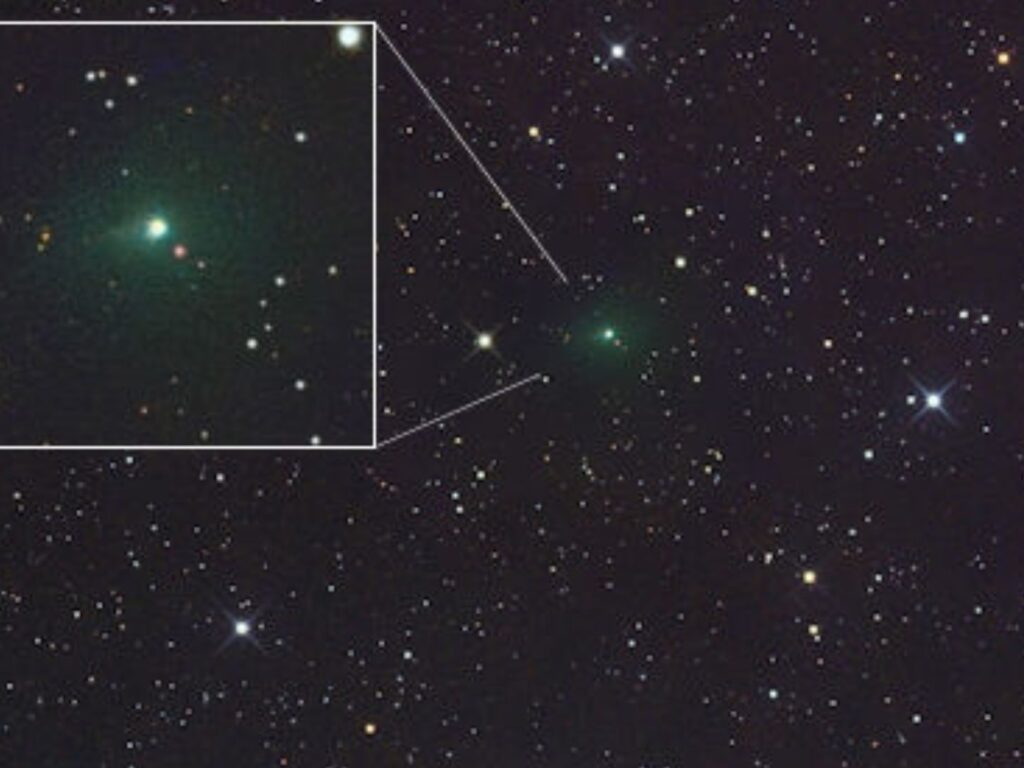
On November 1, 2025, amateur astronomers began capturing 3I/ATLAS in the morning twilight sky using small telescopes. According to reports, a 152-mm Ritchey-Chrétien reflector imaged the comet and its faint tail. Observers were advised to use a low eastern horizon before dawn, dark skies, and a tracking mount if possible.
For the professionals and amateurs alike, the comet is a rare opportunity: interstellar visitors are extremely rare, and such detailed features as multiple jets can give clues to how material behaves under outer-system conditions.
Key observational facts:
| Parameter | Value |
|---|---|
| Perihelion distance | ~1.4 AU (~210 million km) |
| Speed near perihelion | ~68 km/s |
| Jet count | 7+ identified in images |
| Anti-tail presence | Yes — visible early Nov |
| Origin | Interstellar, hyperbolic orbit |
Implications for astronomy
Because 3I/ATLAS comes from outside of our Solar System, it acts as a messenger carrying information about star systems beyond ours. The unexpected jet behavior and mass ejection thus challenge standard comet-models built from Solar System objects. They may hint at more volatile ices, weaker structural integrity, or environmental influences in its original home system.
For planetary scientists and comet researchers, this means we may have to revise models of the composition of comets, their internal structure, and how such objects can survive on long journeys through interstellar space. The mass-loss inferred may also affect trajectory predictions: if much mass is ejected asymmetrically, the object’s path changes non-gravitationally.
What to watch in the coming weeks
- Changes in brightness and tail structure as 3I/ATLAS recedes from the Sun.
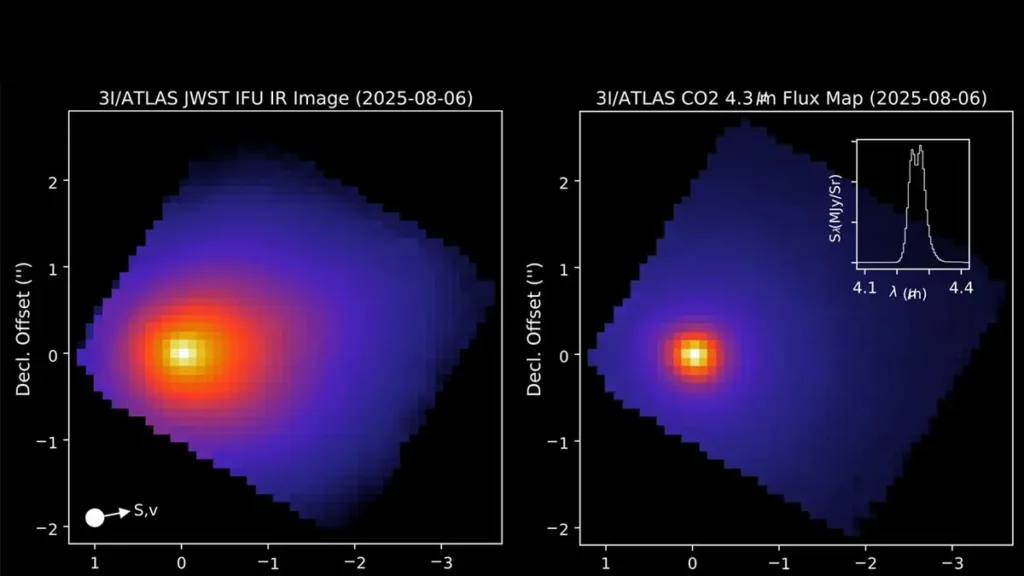
- Spectral analysis of the jets to identify molecules and isotopes: unusual signatures can show non-Solar-System origin chemistry.
- Monitoring for fragments or debris, large mass loss may produce smaller pieces.
- Amateur imaging campaigns to track its tail shape and position, for public outreach.
Watch to know more
Why you should care
This is no ordinary comet; it’s a rare, natural visitor to our neighborhood that will only be around for a fleeting moment-a direct view of materials made elsewhere in the galaxy. Look at 3I/ATLAS through the telescope, and you could be seeing something that might have been wandering around in space for millions of years, crossing your path. It shows us that the Solar System is not insular and, at times, things do come from the stars out there.