
Whenever we gaze into the night sky, we are looking back in time. Each star, each galaxy we see sends us light that has traveled thousands or even billions of years before it reaches Earth. But a question comes up: how far can we really see into the universe?
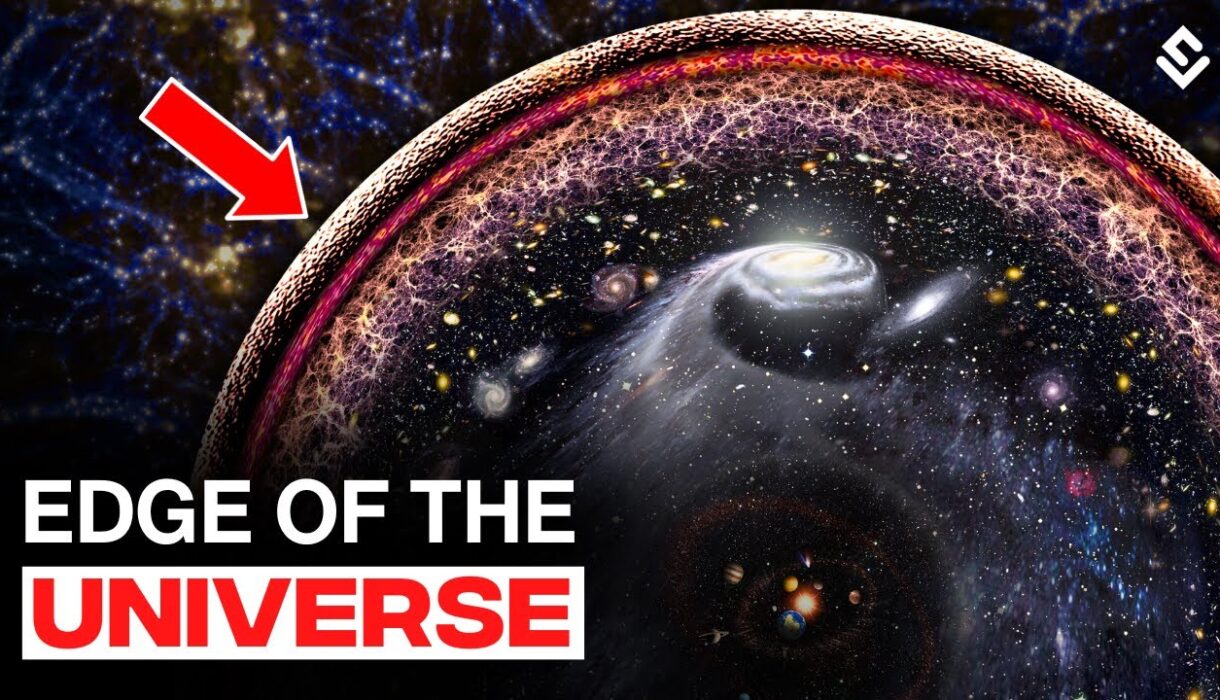
Scientists refer to this as the “observable universe.” It’s the part of the cosmos that light has had time to reach us from since the beginning of the universe. While the universe itself may be infinite, the observable part of it does have a boundary-about 46.5 billion light-years in every direction. That means we can observe a sphere around us that’s roughly 93 billion light-years across.
What is the Observable Universe?
The universe began with the Big Bang, approximately 13.8 billion years ago. Since then, space itself has been expanding-stretching light and carrying galaxies farther apart.
This means that when we see light from a distant galaxy, that light has been traveling for billions of years. But space expanded during that journey, so the galaxy is much farther away from us now than the distance the light traveled. That’s why the edge of the observable universe is not 13.8 billion light-years away but about 46 billion.
That visible bubble depends on the speed of light and the age of the universe. Since nothing can go faster than the speed of light, there is only so much distance that we can view. Beyond that distance, light from distant galaxies has not had enough time to reach us yet.
Seeing Back in Time
Looking farther out in space also means looking further back in time. The light from the Andromeda Galaxy, for example, takes about 2.5 million years to reach us. When you look at it through a telescope, you’re seeing Andromeda as it was long before humans existed.
Even more extreme, the Hubble Space Telescope and the James Webb Space Telescope will be able to detect galaxies that formed just 300-400 million years after the Big Bang. These would be among the oldest objects ever observed. What we cannot see directly is the time before the formation of stars and galaxies; that period of time is called the cosmic dark ages. That era came to a close when the first stars turned on and the universe became transparent to light.
The Cosmic Microwave Background: The Farthest We Can See
The Cosmic Microwave Background (CMB) is the oldest light we can observe. It’s the afterglow of the Big Bang, released about 380,000 years after the universe began.
Before that, the universe was so hot and dense that light couldn’t travel freely — it kept bouncing off particles. When it finally cooled enough, light broke free and began traveling across space. That ancient light still surrounds us today and has been stretched into microwave wavelengths.
NASA’s COBE, WMAP, and Planck satellites have all mapped the CMB in amazing detail, revealing small temperature variations that show the seeds of galaxies and cosmic structures.
What Lies Beyond the Observable Universe?
Beyond the observable boundary, the Universe doesn’t just stop; it keeps on going, but we can’t receive the signals from there due to the finiteness of the age of light.
Astronomers think that regions of space beyond our horizon might be similar to what is visible, with galaxies and dark matter. But it can also be completely different, with different physical conditions, or even different constants of nature.
Some theories say that the universe is infinite, while others, referencing cosmic curvature, say it might wrap around itself, like in a sphere. If one were able to travel fast enough, he or she could end up where they started; this, of course, is just speculation.
Expansion, Redshift, and the Cosmic Horizon
The expansion of space causes something called redshift , the stretching of light waves as galaxies move away. The more distant a galaxy is, the faster it appears to be moving from us.
Eventually, galaxies at extreme distances move away faster than the speed of light due to space expansion. Their light will never reach us, they lie beyond our cosmic horizon.
That means the observable universe is actually shrinking in visibility over time, as more galaxies slip beyond view. In trillions of years, distant galaxies will fade away entirely, leaving only our local group visible.
How We Measure Cosmic Distances
Astronomers use several methods of measurement of cosmic distances:
- Parallax, the apparent shift in position of nearby stars resulting from Earth’s motion around the Sun.
- Standard Candles,objects which have known brightness, such as Cepheid variable stars or Type Ia supernovae.
- Redshift , the observation of how much the light from galaxies has stretched due to expansion.
Putting these together provides a three-dimensional map of the universe, while current facilities like the James Webb Space Telescope, Euclid, and Vera Rubin Observatory push this map deeper than ever before.
Why the Universe is Bigger than We Can See
Our place in space and time defines the observable universe. A civilization billions of light-years away is going to see an entirely different observable bubble, centered on their position.
This does not mean that there is an edge to the universe, just that each observer has a horizon; together, those horizons overlap and cover the one infinite cosmos.
Conclusion: Our Window Into Infinity
The stars you see tonight are a vision across both space and time, the living history of the universe. With the current set of tools at our disposal, we are able to look back to the very dawn of light itself, but what lies beyond is yet unknown.
Upcoming telescopes, such as the Nancy Grace Roman Space Telescope, will both see farther and see more clearly, helping us sharpen the boundaries of our cosmic map. But no matter how powerful our technology ever gets, the universe will always leave some secrets unattainable-a humbling reminder that our cosmic vision, though enormous, will forever be but a glimpse of infinity.