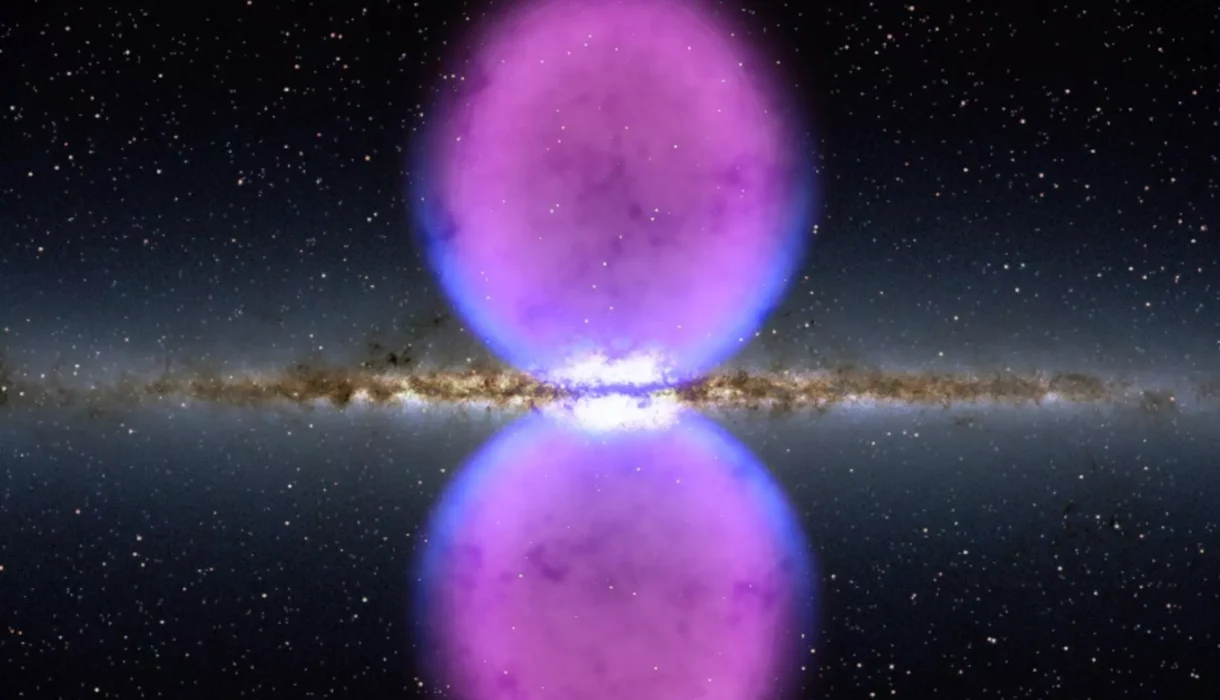

For almost a century, Dark Matter has been one of the biggest mysteries of the universe: we know it should be there, and yet nobody has ever seen it directly. On November 25, 2025, a new study led by Tomonori Totani at University of Tokyo claimed a possible breakthrough. By carefully analyzing 15 years of data from Fermi Gamma‑ray Space Telescope (Fermi‑LAT), the team reports a faint but striking halo of gamma‑ray light surrounding the center of our galaxy, a signal that could emanate from DM particles colliding and annihilating.
What Was Observed ????
Fermi‑LAT has scanned the sky for gamma rays, which represent the highest‑energy form of light, since its 2008 launch. Once the researchers filtered out known sources of gamma rays and mapped the remaining emission, they found a vast, diffuse glow forming a roughly spherical halo around the center of the Milky Way. This glow peaks at photon energies around 20 giga‑electronvolts (GeV).
This halo’s shape and energy distribution are consistent with predictions for annihilation of a popular dark matter candidate: WIMPs, or Weakly Interacting Massive Particles. In theory, if two WIMPs meet, they destroy each other and produce gamma rays. The mass of the WIMPs inferred from this study is roughly 500 times the mass of a proton, which aligns with many dark matter models.
Because dark matter does not emit or absorb ordinary light-so remains “invisible” in telescopes-this gamma-ray halo-if confirmed-could represent the first direct detection of dark matter in action. As Totani wrote, “If this is correct … it would mark the first time humanity has ‘seen’ dark matter.”
New research analyzing observational data from NASA’s Fermi Gamma-ray Space Telescope could signify the first time that dark matter has been directly observed since it was first proposed a century ago.#UTokyoResearchhttps://t.co/Snp5DTeWcW
— UTokyo | 東京大学 (@UTokyo_News_en) November 26, 2025
Fermi‑LAT has scanned the sky for gamma rays, which represent the highest‑energy form of light, since its 2008 launch. Once the researchers filtered out known sources of gamma rays and mapped the remaining emission, they found a vast, diffuse glow forming a roughly spherical halo around the center of the Milky Way. This glow peaks at photon energies around 20 giga‑electronvolts (GeV).
This halo’s shape and energy distribution are consistent with predictions for annihilation of a popular dark matter candidate: WIMPs, or Weakly Interacting Massive Particles. In theory, if two WIMPs meet, they destroy each other and produce gamma rays. The mass of the WIMPs inferred from this study is roughly 500 times the mass of a proton, which aligns with many dark matter models.
Because dark matter does not emit or absorb ordinary light-so remains “invisible” in telescopes-this gamma-ray halo-if confirmed-could represent the first direct detection of dark matter in action. As Totani wrote, “If this is correct … it would mark the first time humanity has ‘seen’ dark matter.”
New research analyzing observational data from NASA’s Fermi Gamma-ray Space Telescope could signify the first time that dark matter has been directly observed since it was first proposed a century ago.#UTokyoResearchhttps://t.co/Snp5DTeWcW
— UTokyo | 東京大学 (@UTokyo_News_en) November 26, 2025
Why This Could Be Groundbreaking
- Bridging theory and observation: For decades, dark matter was inferred only by its gravity, bending light, influencing galaxy rotation, or shaping structure at large scales. This detection would finally provide a real observable signal, bringing DM from abstract theory into physical evidence.
- Particle physics meets cosmology: If WIMPs are real and of the mass range suggested, this would open up new directions in particle physics, pointing toward particles beyond the known “Standard Model.”
- Guiding future experiments: The finding will help refine the searches, both in telescopes and Earth‑based particle detectors, since it will narrow down possible DM properties such as mass, annihilation behavior, and spatial distribution.
Why Scientists Remain Cautious
Despite the excitement, most researchers urge restraint. The center of our galaxy is a chaotic environment full of gamma‑ray sources, pulsars, supernova remnants, cosmic‑ray interactions, etc. Any of these might contribute to or even explain the observed glow.
In fact, similar gamma-ray “excesses” have been debated for years. Previous work suggested possible DM signals, but those claims were never universally accepted because of uncertainties about background sources.
The authors themselves stress the need for independent verification. That means looking for similar gamma‑ray signals in other dark‑matter–rich zones, such as small companion galaxies, so-called dwarf galaxies, orbiting the Milky Way, where astrophysical “noise” is lower.
What’s Next: Confirmation or Refutation
- Repeat observations: Independently, other teams would need to analyze the Fermi data. If the halo signal persists under different methods, confidence will grow.
- Look elsewhere: If similar gamma‑ray halos show up around other galaxies or dark‑matter–rich structures, that would strengthen the DM interpretation.
- Improved telescopes: Future observatories, such as the CTA, will possess higher sensitivity and resolution, which will help in ruling out astrophysical sources and highlight faint or diffuse signals more readily.
Watch to know more
What This Means for the Big Picture
Understanding dark matter is crucial to cosmology. It constitutes approximately 85% of all the matter of the universe. Without DM, galaxies would not hold together, including our own. However, for decades, it remained hidden, invisible from any type of telescope because it does not interact with light.
If this new gamma-ray halo truly arises from dark matter annihilation-if WIMPs are real-then we may at last be peeling back the darkness surrounding our universe. That could open the door to a new era in cosmology, in which what was once cosmic mystery becomes observable reality.
But until other teams confirm the findings, and rule out more conventional explanations, this remains a possible first detection, not a firm discovery.



Finally got around to using the jili18applogin. Login was smooth . Definitely a convenient way to play. Lets see if my luck has improved, maybe I’ll give it a whirl daily jili18applogin.