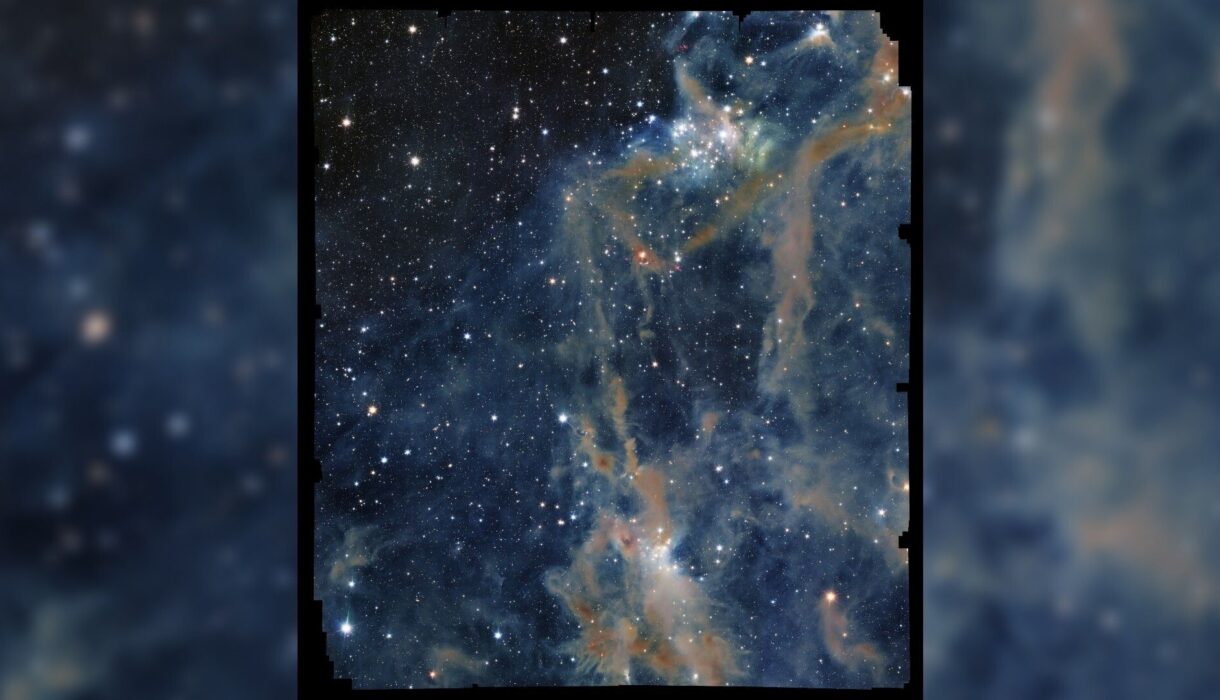

Astronomers are abuzz over a stunningly detailed image just released from the European Space Agency’s Euclid Space Telescope, which has imaged a dense, star-forming dark cloud in the Orion constellation. The nebula, called LDN 1641, lies about 1,300 light-years from Earth and is one of the most active stellar nurseries in our galactic neighborhood. While dark clouds like this are nothing particularly new, Euclid’s ability to capture sharp structure in high resolution gives scientists fresh insight into where and how new stars are born.
The beauty of this picture is how it cuts through the thick curtains of dust that ordinarily obscure this region of space. In visible light, LDN 1641 appears dark and foreboding. Euclid’s deep near-infrared imaging, however, enables us to see inside and reveals pockets of denser gas and dust-the places where gravity is already causing collapses that may be leading to the formation of new stars. These are places where young, still-forming stars might hide, shielded from optical telescopes by dust.
Why This Nebula Is a Stellar Nursery
Dark nebulae, such as LDN 1641, are cold, dense clouds of gas and dust. Under the influence of gravity, parts of these clouds can collapse, forming new stars and planetary systems. Since much of the visible light is blocked by the dust, much of the process of star formation remains hidden from traditional telescopes, making infrared and space-based instruments like Euclid invaluable for unmasking the early phases.
The new Euclid image shows the nebula filaments well delineated. These filaments may trace the paths where gas is flowing inward, feeding dense cores that could eventually become stars. The structure also hints at turbulence within the cloud-gas and dust being pushed and pulled by internal motion and magnetic fields. Understanding this aids astronomers in refining models of how star formation actually begins.
Implications for Stellar and Galactic Evolution
But studying LDN 1641 with Euclid is more than a pretty picture-it gives important clues on how galaxies evolve. Star formation is the process shaping galaxies over long times. By observing a nebula this close and so clearly, scientists can test how efficient star formation is in these dense clouds and which physical factors matter most: gravity, turbulence, magnetic fields, or radiation.
Moreover, LDN 1641 is relatively “young” in a galactic sense. By comparing it with older star-forming regions, researchers can learn how stellar nurseries evolve. Are some clouds more efficient at making stars? Do certain filaments survive long enough to create massive stars? Euclid’s data may help answer such questions.
Challenges and Ongoing Work
Even with Euclid’s powerful imaging, a number of big questions remain. For example:
- Star count: How many protostars (very young stars) are hidden inside LDN 1641? These can only be detected by follow-up observations with other telescopes.
- Mass distribution: what fraction of the cloud’s mass is in dense cores likely to form stars and how much remains in a more diffuse form?
- Magnetic fields probably help to shape the filaments and determine which will collapse: measuring magnetic strength in such regions is exceedingly difficult.
- Time evolution: Are these filaments stable? Will they eventually break up, or will they feed growing protostars?
To address these, astronomers will combine Euclid’s data with observations from other instruments, like the James Webb Space Telescope or ground-based radio telescopes, that can look deeper into the nebula, or detect molecules and magnetic signatures.
Watch to know more
Why This Discovery Matters to Us
For astronomy enthusiasts, this is a powerful reminder that the cosmos are alive: stars are not only relics of the past but are being born right now, hidden inside dark clouds and only revealed by sensitive instruments. For humanity, understanding star formation is part of understanding our origins: the Sun, Earth, and all known life began in a cloud not unlike LDN 1641.
The discovery also underlines the importance of missions such as Euclid, which was basically designed for dark energy and cosmology but keeps on providing exciting findings into different areas in astrophysics by proving that space telescopes are flexible and powerful.