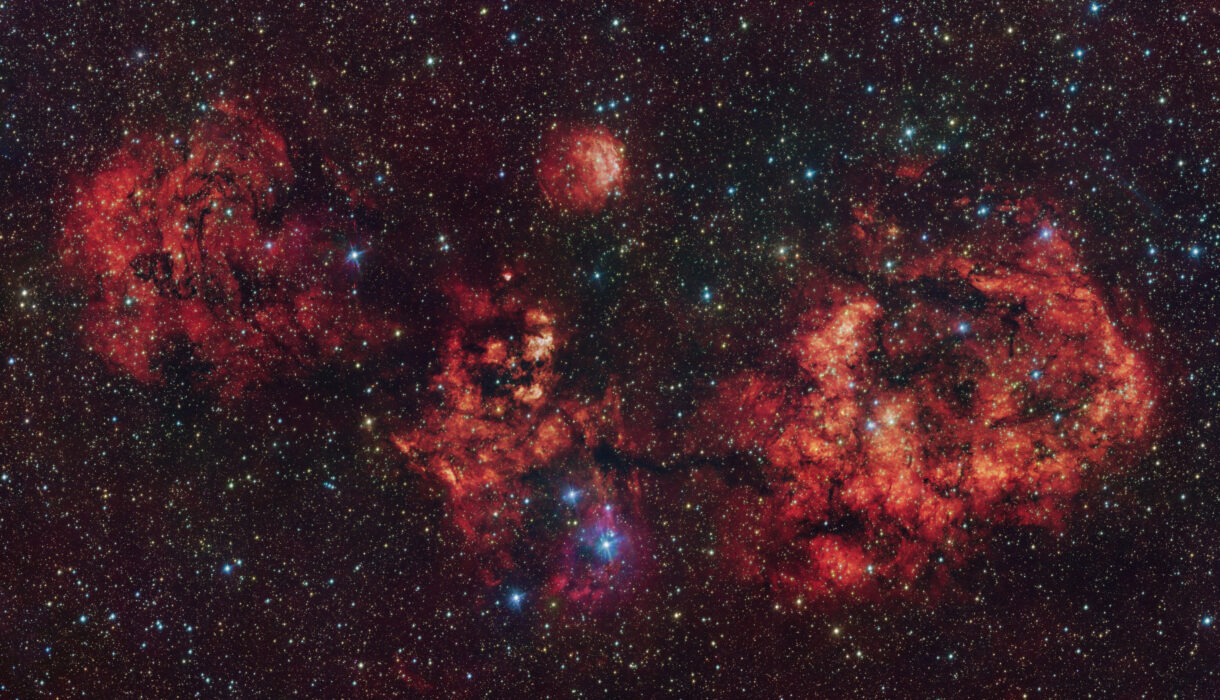

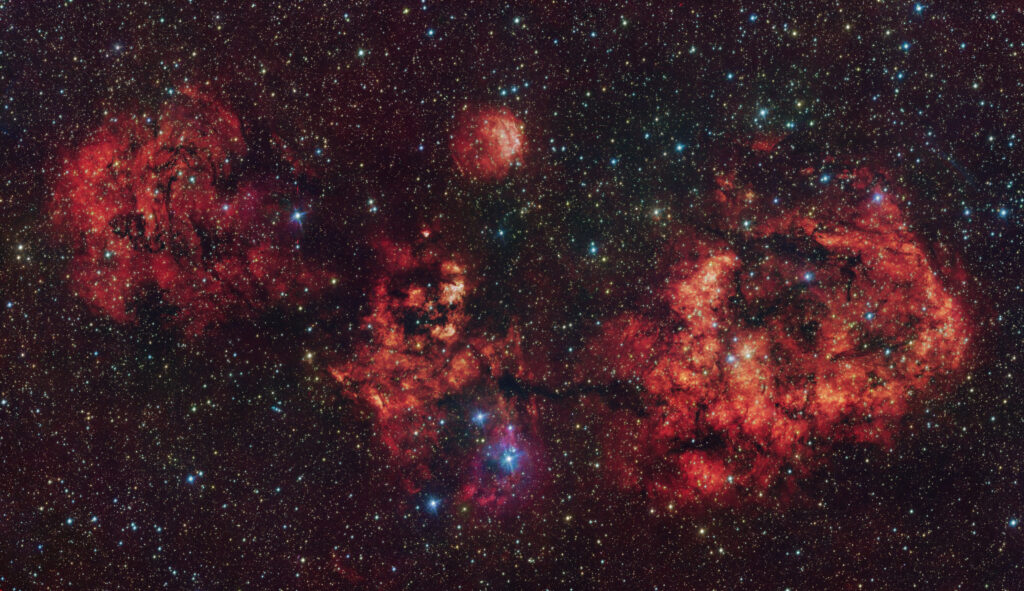
Astronomers have released an impressive wide-field image of a gas and dust cloud that resembles a flying bat. This image was captured with the VLT Survey Telescope (VST) at ESO’s Paranal Observatory in Chile. It combines visible and infrared data, showing the cloud in greater detail. The brightest areas are known as RCW 94 and RCW 95, which together create a silhouette resembling wings and a body, hence the name “cosmic bat.”
What we are actually seeing
The bat shape is not a single object; it is a complex area filled with glowing hydrogen gas and darker dust lanes. Young, hot stars within the cloud emit strong ultraviolet light. This radiation strips electrons from hydrogen atoms, which then recombine and emit a red glow, creating the bright light we observe. Dust in the cloud blocks and reddens light, shaping the darker parts that highlight the wings and body. RCW 94 and RCW 95 are the brightest knots in this structure and indicate active star-forming regions.
But why visible light and infrared matter? Visible light brings out ionized gas and hot stars, but dust can block young stars from being seen in optical light. By including infrared observations (like those from ESO’s VISTA telescope), astronomers can look through some dust to reveal young stars still enveloped in their birth materials.
The combined image provides a broader view: the hot ionized gas brightens the nebula, while warm dust and hidden stars promote star formation. This complementary perspective helps astronomers identify where new stars are forming and how they influence their surroundings.
How such star nurseries work
Star formation starts when gravity pulls gas into dense clumps within a molecular cloud. If a clump becomes dense enough, it collapses and forms a protostar. Massive stars form quickly and produce intense radiation and stellar winds. These forces carve out cavities, compress nearby gas, and sometimes trigger new star formation in adjacent clumps. The wing-like arcs and cavities in the RCW complex show evidence of these feedback processes happening over many light-years. In short, the bat shape tells a story of birth, pressure, and change.
Location and scale
RCW 94 and RCW 95 are located in the southern Milky Way near the constellations Circinus and Norma. This complex is about ten thousand light-years from Earth. At that distance, the cloud spans a vast area of the sky, comparable to several full moons, but its complete form is best viewed with wide-field survey instruments like the VST. The scale and detail visible in the new image allow astronomers to study both global and local structures.
Scientific value beyond the Halloween shape
While the bat silhouette makes for a memorable image, the data behind it hold significant scientific value. Astronomers use this information to measure gas temperature, density, and chemical composition by examining emission lines. They also track gas motions using Doppler shifts, which reveal flows, turbulence, and shock fronts. Multiwavelength data uncover embedded young stars and protostellar jets that optical light alone might miss. Together, these insights help create a detailed physical model of how this region forms stars and evolves.
Capturing such a wide and detailed view requires careful planning and image processing. The VST took multiple deep exposures with different filters to isolate emission and continuum light. Data reduction eliminated instrumental noise and assembled the frames into a mosaic that covers a large area. Infrared frames from VISTA were aligned with the optical frames so that structures hidden in dust could be revealed. Color maps were then applied to highlight physical differences, such as red for hydrogen emission and infrared tones for warm dust, making the physics visually clear.
What astronomers will do next
The VST image serves as an invitation for further study. Spectroscopic surveys of the region will measure gas speeds and chemistry in detail. Radio observations will map cold molecular gas, which is the raw material for future stars. High-resolution infrared imaging will investigate the youngest protostars and disks where planets may form. Each layer of follow-up research adds to the narrative: how mass moves, how stars are born, and how feedback shapes the cloud.
Watch to know more
Conclusion
The “cosmic bat” is a reminder that the sky can surprise and inspire us while also teaching us important scientific concepts. A striking image captures attention, but the true value lies in the measurements and models that turn color and shape into knowledge about star life cycles. Whether you see a bat or a sweeping nebula, RCW 94 and RCW 95 vividly illustrate how wide-field astronomy combines art and research to deepen our understanding of the Milky Way.