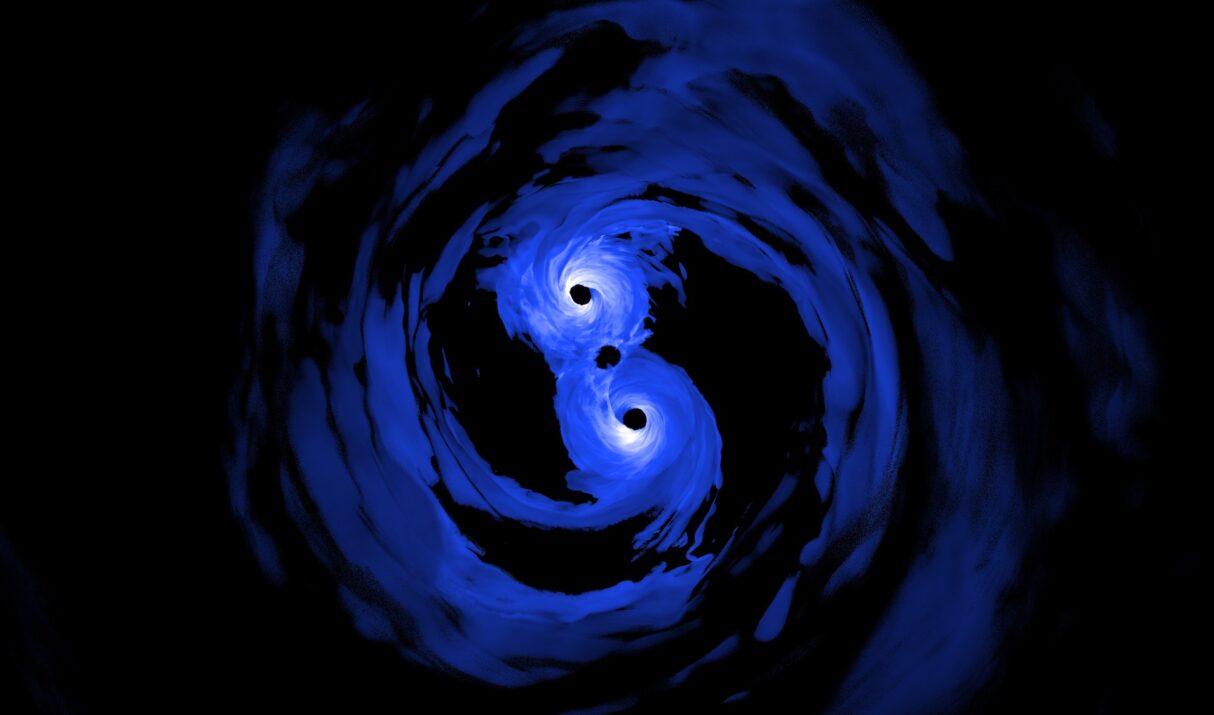

Tiny ripples stacking from many cosmic sources could be stronger than we thought, now offering new ways to study the early universe.

Scientists explore whether exotic matter could stabilize wormholes, cosmic tunnels that might let us travel across the universe through spacetime shortcuts.

A new study suggests we may have finally glimpsed dark matter, gamma rays from our Milky Way’s core might be its long‑lost signal.

The mirror universe theory proposes a parallel copy of our world, helping explain why matter dominates over antimatter and the nature of dark matter.

What if our 3D universe is actually a projection encoded on a two‑dimensional boundary? The holographic principle offers this radical possibility.

Astronomers uncover a distant galaxy blazing with star formation at 180 times our Milky Way’s rate, reshaping our view of early cosmic growth.

Discover how far we can see into the universe, what defines our cosmic horizon, and why some regions remain forever hidden.

New research suggests the universe’s expansion is now decelerating rather than accelerating, challenging dark energy and rewriting cosmic destiny.

A winged cloud of glowing gas and dust, RCW 94 and RCW 95, forms a spooky and mysterious “cosmic bat” in our galaxy’s southern sky.