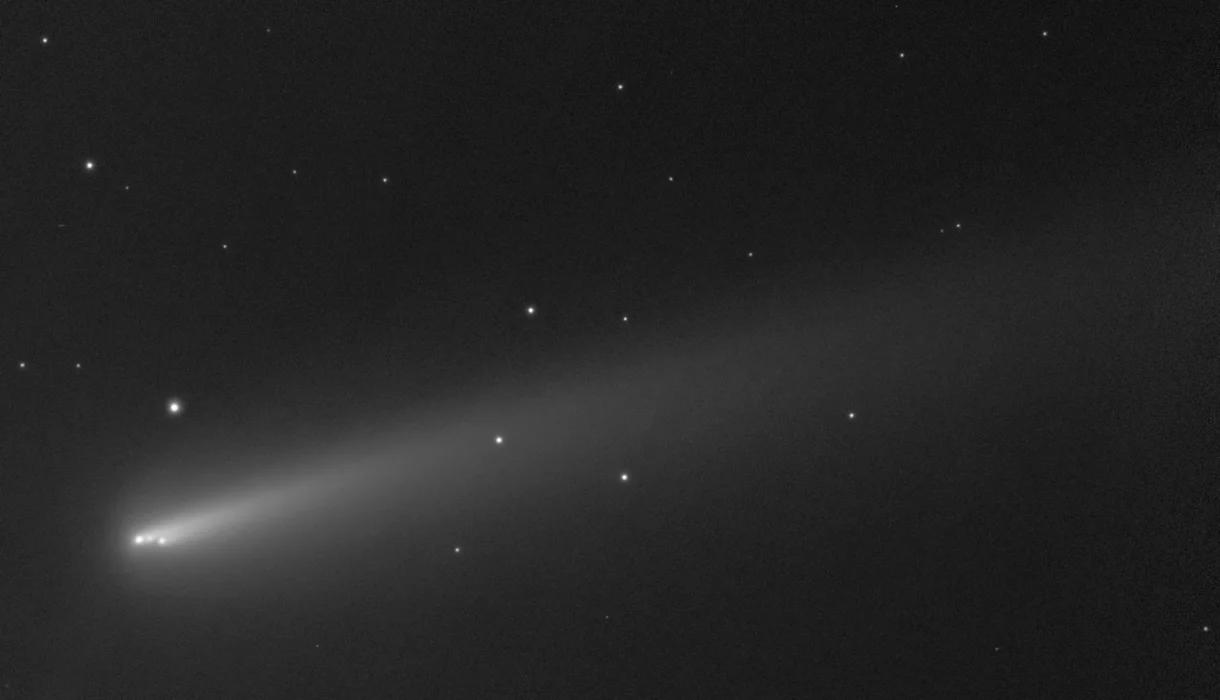

Comets, glowing heads, and long tails-their icy origins quite far from the Sun-tend to induce wonder. But some comets do not always emerge unscathed from their solar passages. Recently, one such comet-C/2025 K1 commonly referred to as ATLAS, dramatically broke apart to give astronomers and sky-watchers a rare opportunity to observe the final moments of a comet.
Discovered on 24 May 2025 by the Asteroid Terrestrial‑impact Last Alert System (ATLAS), this comet started its path from the very far reaches of the Oort Cloud. It followed a long, elongated orbit; on 8 October 2025, it passed closest to the Sun (perihelion) at a distance of about 0.33 astronomical units (AU). That close approach exposed the comet to intense heat and solar stress.
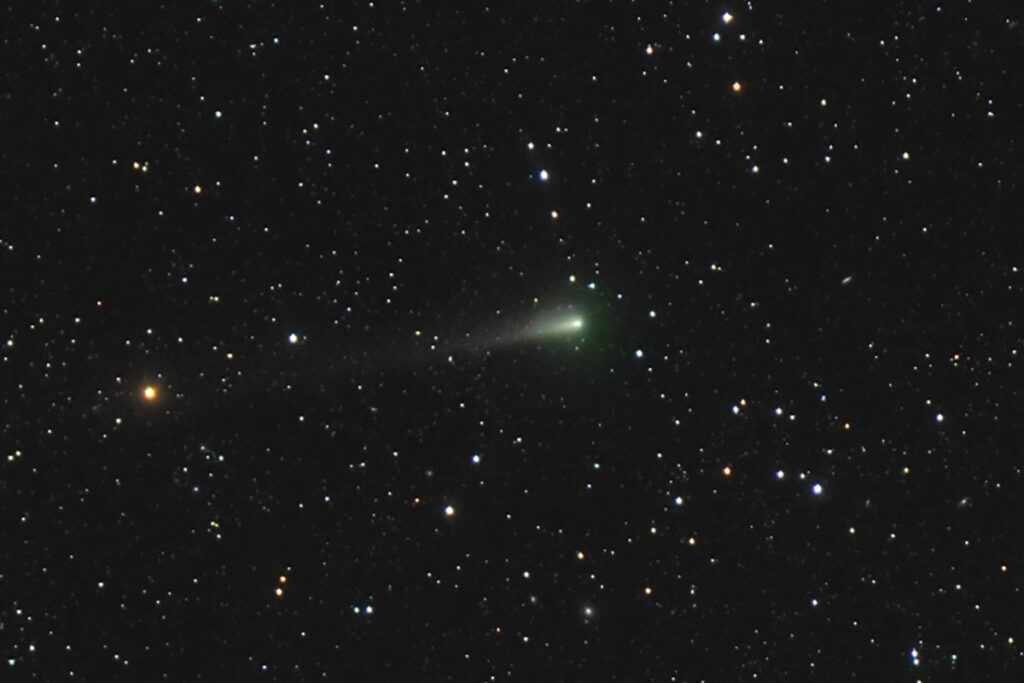
Initially, C/2025 K1 brightened modestly – as solar heat caused its ices to sublimate, forming the now-familiar coma and tail. Observers in early November noted a sudden surge in brightness, a hint that the comet might be undergoing internal changes. But what came next was far more dramatic: in the nights following November 10, astronomers watched the comet’s nucleus break into multiple pieces.
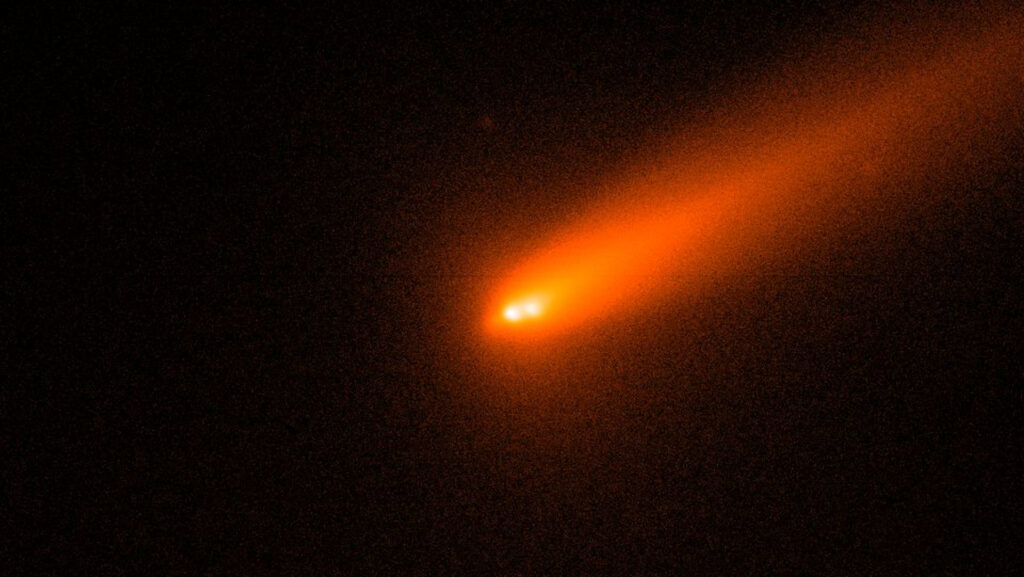
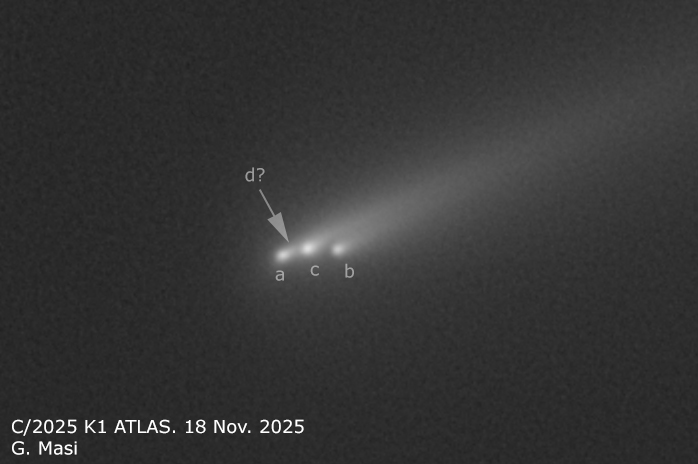
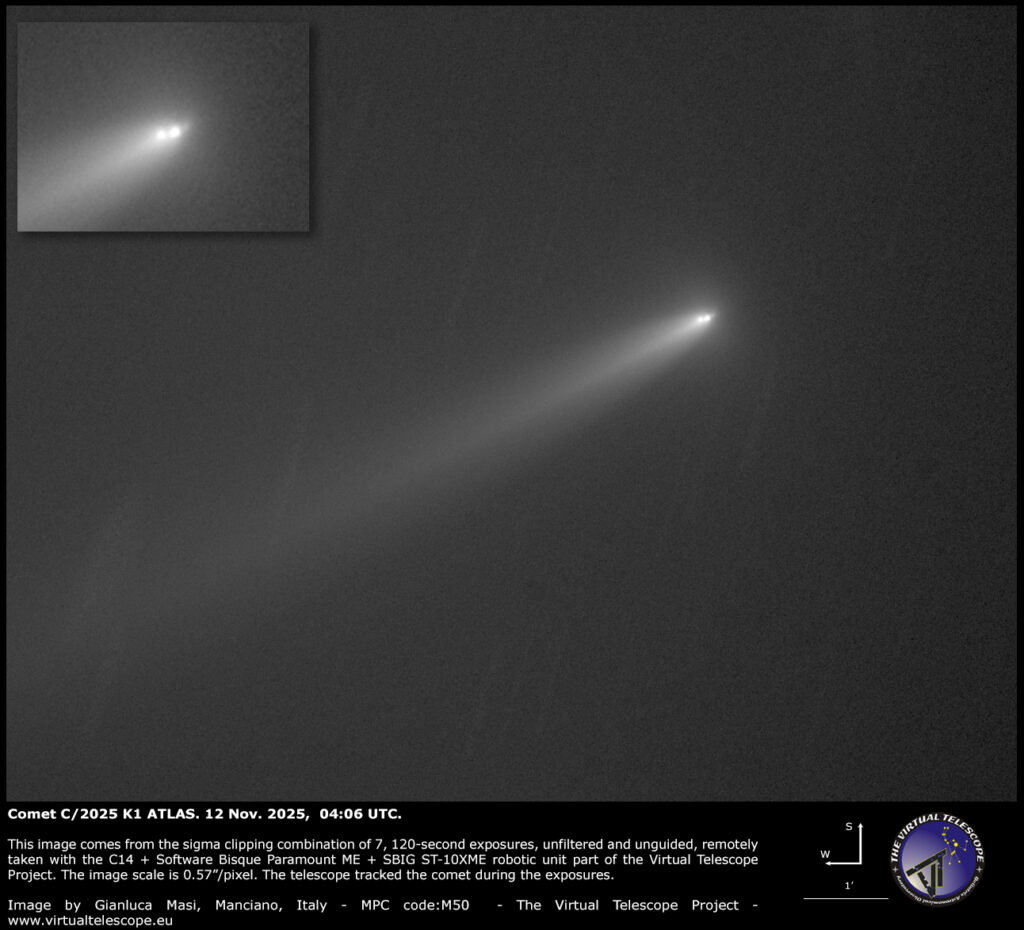
By November 11–12, ground‑based telescopes, such as the 1.82‑meter Copernicus telescope at the INAF Asiago Observatory in Italy, clearly resolved two bright pieces separated by about 2 000 km, with a third fainter fragment seen nearby. Within days, some were even reporting a possible fourth piece.
Why Did It Break Apart?
Comets are fragile. They are composed of ices, dust, and loosely bound rock. As a comet nears the Sun, it heats up; ices vaporize into gas, generating pressure beneath the surface. If the internal structure is too weak, and the pressure or thermal stress is great enough, the nucleus will crack. That appeared to be what happened to C/2025 K1 (ATLAS).
Because this comet was “dynamically new”, meaning it had likely never previously come this close to the Sun, its nucleus may have been more fragile than those of periodic comets. Its first perihelion passage likely exposed deep, volatile-rich layers that had been previously undisturbed-increasing the chance of fragmentation.
In the case of K1/ATLAS, observations show the breakup occurred in a “hierarchical fragmentation” pattern: first a major split, then smaller pieces shedding off, a process captured by both space‑based and ground‑based telescopes.
What Scientists Learn from This Event
- Interior structure of comets: A comet breakup gives a great view of its interior structure. Fragile comets likely have voids or weak cohesion, clues about how comets formed billions of years ago.
- Comet composition: When cometary ices sublimate and fragments drift apart, researchers can sample fresh material from deep inside – offering a unique look at primordial solar system matter. Spectroscopy before breakup indicated very low content of carbon‑bearing molecules in K1/ATLAS, making it “carbon-poor,” a rare trait.
- How comets respond to solar heating: The event which has taken place shows what happens when a first-time comet undergoes intense heating; this helps refine models of the survivability of comets, fragmentation risk, and lifetime inside the inner solar system.
- Real-time comet evolution: Modern telescopes and global collaboration allow us to watch these changes as they happen. K1/ATLAS will likely remain visible for telescopes or binoculars for some time, though as a faint, fragmenting cloud rather than a bright single comet.
What’s Next: Tracking the Remnants
Observers around the world are now following the fragments’ motions. The fragments slowly drift apart, spreading dust and gas, eventually forming a debris cloud. This debris could offer a diffuse but scientifically rich target for spectroscopy and photometry over coming weeks.
Astronomers hope to learn how the comet will behave as its fragments move further apart, how quickly the dust disperses, and whether any fragment survives long term. The event also emphasizes the importance of rapid follow-up observations of comets after perihelion, especially for dynamically new ones.
Watch the Breakup — Real Footage
This video captures the dramatic moment the comet shattered after its close solar encounter. It gives a vivid sense of how fragile comet nuclei can be and shows real‑time separation of fragments, a rare event recorded for modern science.
Comet C/2025 K1 (ATLAS)’s breakup reminds us that the solar system remains a place of change and drama. What begins as a faint icy wanderer can end up as dust and fragments, scattered across space. For scientists, such events are not losses, they are opportunities. They let us peek into the primordial materials that built planets. They show us how comets evolve or disintegrate when faced with solar heat. And they allow us to test theories about comet structure, composition, and longevity.
If you enjoy astronomy, keep your eyes on the night sky, and on telescope feeds. Every now and then, the universe performs a cosmic show.


89pkr! Poker is my game! I’m always looking for a good place to test my skills, and maybe even make some money. Hope to find some good players there! May the best hand win at 89pkr
Iwinfortune? Name’s got a nice ring to it, haha! I’ve heard they have some decent slots. Could be worse! check them out and try your luck: iwinfortune