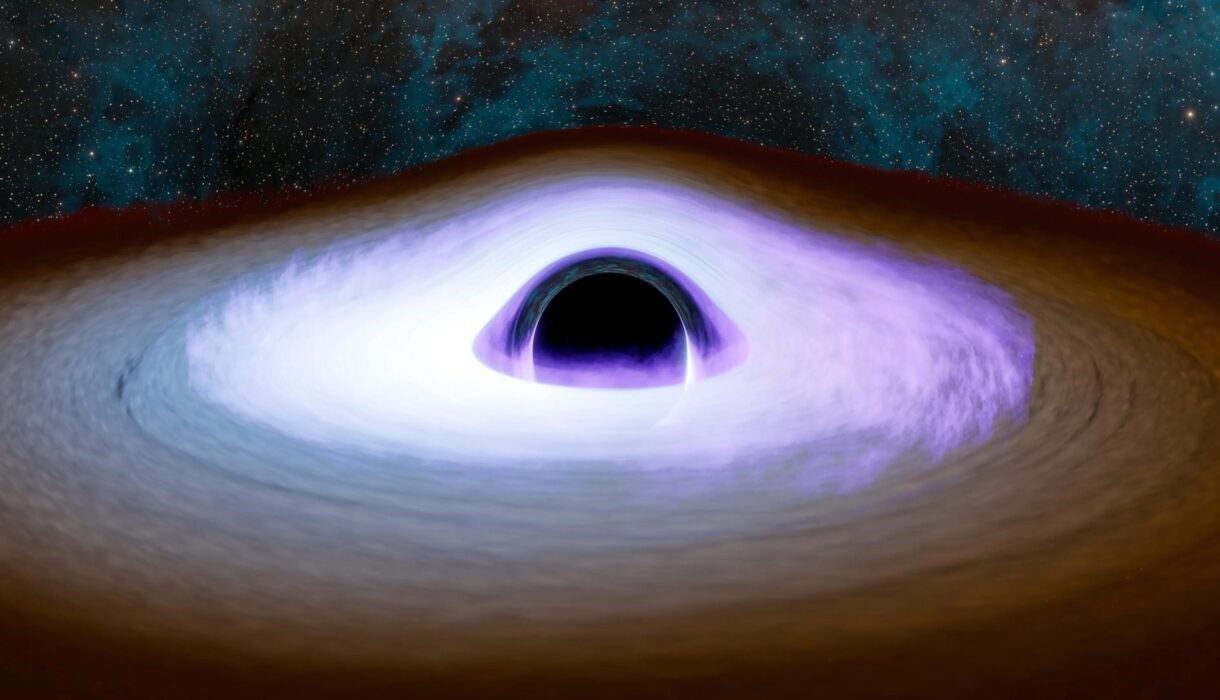

Astronomers have just spotted what may be the brightest flare ever recorded from a supermassive black hole. Lying about 10 billion light-years away, the black hole at the heart of galaxy J2245+3743 exploded in an outburst equivalent to about 10 trillion suns. The event, first detected back in 2018 and monitored for years since then, is reported in the journal Nature Astronomy.
What happened and how we observed it
It began innocently enough in 2018, when the Zwicky Transient Facility first detected the brightening of the galaxy’s core. But over time, it became clear that this was no ordinary AGN flicker: detailed follow-up revealed the flare was brightening by more than a factor of 40 compared to earlier records. The central black hole is estimated at about 500 million solar masses, and the energy released from the burst is approximately 10^54 ergs — the equivalent of completely converting one Sun-mass entirely to light.
The huge distance also means we are seeing this event as it appeared long ago – when the universe was only ~3.8 billion years old. Due to the expansion of the universe, time appears to be stretched: what could have occurred in, say, two years near the black hole is observed as seven years here. This phenomenon is known as cosmological time dilation.
BREAKING🚨: Star-eating black hole just unleashed a Flare that was 10 trillion times brighter than the sun──11 billion light-years from Earth pic.twitter.com/gEqBOyrd0V
— All day Astronomy (@forallcurious) November 5, 2025
It began innocently enough in 2018, when the Zwicky Transient Facility first detected the brightening of the galaxy’s core. But over time, it became clear that this was no ordinary AGN flicker: detailed follow-up revealed the flare was brightening by more than a factor of 40 compared to earlier records. The central black hole is estimated at about 500 million solar masses, and the energy released from the burst is approximately 10^54 ergs — the equivalent of completely converting one Sun-mass entirely to light.
The huge distance also means we are seeing this event as it appeared long ago – when the universe was only ~3.8 billion years old. Due to the expansion of the universe, time appears to be stretched: what could have occurred in, say, two years near the black hole is observed as seven years here. This phenomenon is known as cosmological time dilation.
BREAKING🚨: Star-eating black hole just unleashed a Flare that was 10 trillion times brighter than the sun──11 billion light-years from Earth pic.twitter.com/gEqBOyrd0V
— All day Astronomy (@forallcurious) November 5, 2025
Possible causes: What triggered the blast?
Researchers considered several scenarios:
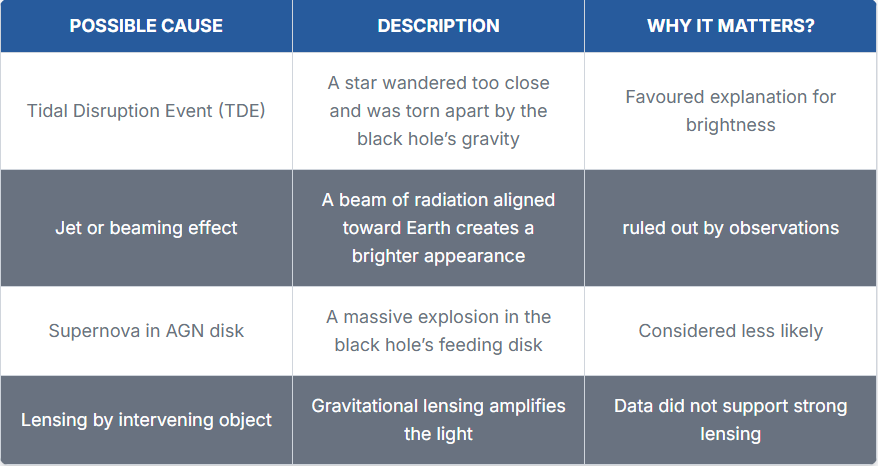
While the analysis here favors a TDE involving a ≥ 30-solar-mass star that strayed into the black hole’s accretion disk, most TDEs involve dormant black holes, and this one occurred in an already active AGN.
What this means for astronomy
- Extreme black-hole feeding: The sheer luminosity challenges theories of how super-massive black holes consume and energize matter.
- New window on early universe: Because the object is so far away, it gives insight into black hole behaviour when the universe was younger.
- Long-term monitoring is important because the detection was possible due to years of survey data, showing how such rare, slow-evolving cosmic events may well hide in plain sight.
How astronomers monitored the event
The key instruments and efforts included:
- Zwicky Transient Facility (ZTF) at Palomar, initial detection
- W. M. Keck Observatory in Hawaii, spectrum and distance measurement.
- NASA’s WISE mission data helped rule out beaming.
- Observational analysis of the light-curve and decay rate over several years to assess energy output and fading behaviour.
Why the "record" matters
Compared to previous flares, this event is about 30 times brighter than any previously recorded in an AGN context. It sets a new high-water mark for tidal-disruption-style flares and shows that extreme events may be far more powerful-and rare-than we realised.
What we still don't know
- Exactly how many stars around active supermassive black holes may be large enough to trigger such blasts.
- How common these extreme flares are-many may simply go unnoticed if they occur in distant galaxies.
- Whether this event represents a new class of black-hole activity.
- How the physics of the accretion disk and star-death interplay differs in AGN versus quieter galaxies.
Why you should care
This is not just “another cosmic explosion.” It reveals a black hole in full feeding frenzy, pushing boundaries of how much energy a black hole can release. For you gazing at the night sky, it is a reminder that our universe is still wild, dynamic, and full of surprises. This event is one for the record books-and our future models of galaxies and black-hole growth will be rewritten around it.